Bible Dictionary B 2
Bishop.
The Greek word ἐπίσκοπος is once translated 'overseer,' Acts 20:28, and this occurrence shows conclusively that the 'elders' and the 'bishops' were the same. Paul called for the elders of the church at Ephesus, Acts 20:17, and called them 'overseers.' The same thing is seen in the epistle to Titus: Paul left Titus in Crete to "ordain elders in every city . . . . for a bishop must be blameless." Titus 1:5-7. The above two passages prove that, instead of a bishop being set over a large district, with inferior clergy (as they are called) under him, as is now the custom in Christendom, each city had more than one bishop or overseer, and at that time there was only one assembly in a city. Titus was to ordain (literally 'to appoint') elders in every city.
In Titus 1: and in 1 Timothy 3:1-7 the qualifications necessary for a bishop are given. Special gifts are not mentioned, but moral qualities are essential. A bishop must be blameless, the husband of one wife, having his children in subjection, etc.; but he must be able to 'take care' of the church of God, and be 'apt to teach.' The bishops of Ephesus were exhorted to take heed to all the flock, and to feed the church of God. Though an apostle or his delegate was the instrument used in the appointment of the bishops, and thus the unity of the church was preserved, Paul could say "the Holy Ghost hath made you overseers." Acts 20:28.
Elders were established to exercise godly care in the undivided local assembly — to 'shepherd' the flock. Any attempt to appoint them now would be, not only without the necessary apostolic authority, but would ignore the divided state of the church. Such elders could only assume authority over a fragment of the church in a locality, and that with no apostolic sanction. That no security for the church was to be found in them is proved by the warning of the apostle, that among themselves should men arise, speaking perverse things; and in view of this he commends them, not to some ecclesiastical authority, or to a church council, but "to God, and to the word of his grace," a resource which all Christians still have. Happily there are now servants of God who care for the saints, those who are 'apt to teach,' and gifted to feed the flock of God; and who, without any apostolic appointment, addict themselves to the work of the ministry, as did the house of Stephanas in early days. 1 Cor. 16:15. All such should be acknowledged, and be highly esteemed for their work's sake. In one passage the Lord is Himself called the Shepherd and Bishop of souls; and who can care for and feed His saints as He? 1 Peter 2:25.
Bishoprick,
ἐπισκοπή The word is 'office' in Ps. 109:8, which passage is quoted in the N.T. where the office, is 'apostleship,' for which one was chosen to take the place of Judas Iscariot. Acts 1:20.
Bithiah. [Bithi'ah]
Daughter of some Pharaoh and wife of Mered, a descendant of Judah. 1 Chr. 4:18.
Bithron. [Bith'ron]
District on the east of the Jordan. 2 Sam. 2:29. The name signifies 'the broken ground,' and 'all Bithron' implies a district.
Bithynia. [Bithyn'ia]
A large district in the north of Asia Minor, bordering on the Black Sea. Paul and Timotheus attempted to go into Bithynia, but the Spirit suffered them not. Acts 16:7. Peter addressed his first Epistle to those of the dispersion of Bithynia, etc. 1 Peter 1:1. It was then a Roman province: it is now called Kastamuni, a part of Turkey in Asia.
Bitter Herbs.
No particular herbs are specified by name, indeed the word 'herbs' is added in the A.V., so that it is literally 'bitterness.' The paschal lamb was to be eaten with 'bitter herbs,' doubtless signifying the sense in the souls of those partaking that it was for their sins the victim was slain. Ex. 12:8; Num. 9:11.
Bittern.
The word in the LXX, ἐχῖνος, signifies 'hedgehog or porcupine,' and this rendering is preferred by some Hebrew scholars for the Hebrew word. qippod; but as in two of the passages it is mentioned with a bird called the Cormorant, it is more probably a bird, and the description well agrees with the habits of the bittern, for the passages point to desolations because of the judgements of God. Isa. 14:23; Isa. 34:11; Zeph. 2:14. The bittern is a bird that shuns society, and it is at home in any desolate marshy place. The spots and marks on its feathers correspond with the colours of the reeds among which it dwells, so that it escapes observation. Its doleful cry has often been treated as an omen of evil.
Bitterness, Gall of.
The word χολή, 'gall,' occurs in Matt. 27:34. and the word for ' bitterness,' πικρία, in Rom. 3:14; Eph. 4:31; Heb. 12:15. The translation in Acts 8:23 is literal, except that it should be 'a gall of bitterness.' Peter saw that Simon was still in the state of nature which is only bitterness.
Bizjothjah. [Bizjoth'jah]
Town in the south of Judah. Joshua 15:28.
Biztha. [Biz'tha]
One of the seven eunuchs of Ahasuerus. Esther 1:10.
Black.
Under the figure of a bride the remnant of Israel says, I am 'black,' describing herself as having become dark or swarthy by the rays of the sun; the scorching effect of affliction, Cant. 1:5-6: 'burning instead of beauty.' Isa. 3:24. The kingdom of the Medes and Persians is described as a chariot with 'black' horses, Zech. 6:2, 6; and in the Revelation, in the third seal a rider on a 'black' horse betokens scarcity. Rev. 6:5. It is symbolical of what is dismal and threatening.
Blains.
Inflamed ulcers on the body, as from boils, on the Egyptians and the magicians in the sixth plague. Ex. 9:9-10.
Blasphemy.
In scripture this does not always refer to speaking evil of God, to which the word is now restricted. The same Greek word is translated 'railing' in 1 Tim. 6:4; Jude 9; and 'evil speaking' in Eph. 4:31, as it might well be rendered elsewhere. Blaspheming the name of the Lord was under the Jewish economy punishable by death: the son of Shelomith who had married an Egyptian, was stoned to death for this sin. Lev. 24:11, 14, 23. The blasphemy against the Holy Ghost was attributing the Lord's action of casting out demons to the agency of Satan — a sin which should not be forgiven in this age nor in the age to come. The context shows that 'the unpardonable sin' refers to this particular form of blasphemy. Matt. 12:24-32.
Blastus. [Blas'tus]
Chamberlain of Herod Agrippa I: Acts 12:20.
Blessing.
There are two distinct applications of the word 'blessing.' God blesses His people, and His people bless God, the same word being constantly used for both. It is obvious therefore that it must be understood in more senses than one. Again, we read that "the less [or inferior] is blessed of the better," Heb. 7:7; and though this refers to Melchisedec blessing Abraham, the same thing is true respecting God and His creatures: in bestowing favours God is the only one who can bless. The Christian can say, God hath blessed us with all spiritual blessings in the heavenlies in Christ," Eph. 1:3; but the same verse says, "Blessed be the God and Father of our Lord Jesus Christ," meaning "Thanks be to the God and Father of our Lord Jesus Christ." This signification is further made clear by the records of the institution of the Lord's supper. In Matthew and Mark the Lord took bread, and 'blessed.' In Luke and in 1 Cor. 11:24 He took bread and 'gave thanks.' "Every good gift and every perfect gift is from above, and cometh down from the Father of lights." James 1:17. This is God blessing us, and for which we in return bless God by giving thanks, by praise and worship.
Blindness.
Used metaphorically to describe the state of man by nature under the influence of Satan, 2 Cor. 4:4; also a professing Christian who hates his brother, 1 John 2:11; also the state of Israel in their heartless profession, Matt. 23:16-26; and the judicial blindness on Israel. John 12:40. In Rom. 11:7, 25; 2 Cor. 3:14; Eph. 4:18, it is rather 'obdurateness or hardness,' from πωρόω,'to harden.'
Blood.
The blood of man is claimed by God; for the 'life is in the blood;' 'the blood is the life.' It therefore must not be eaten; if not offered in sacrifice it must be 'poured upon the earth as water.' "Whoso sheddeth man's blood, by man shall his blood be shed." The blood also maketh atonement for the soul: it must be poured out upon the altar. Gen. 9:4-6; Lev. 17:10-14; Deut. 12:23-25; Acts 15:29. In the O.T. dispensation everything in the tabernacle, the priests and their dresses were purged and sanctified by blood, everything being sprinkled with blood, including the book of the law and the people. Heb. 9:18, 21. This was typical of the blood of the Lord Jesus, which has accomplished everything for the Christian: with His blood He 'purchased' us, Acts 20:28; 'justified' us, Rom. 5:9; 'redeemed,' Eph. 1:7; 'sanctified,' Heb. 13:12; 'cleanseth us from all sin,' 1 John 1:7; etc.
Blood, Avenger of.
See AVENGER.
Blue.
This colour was used extensively in the hangings of the tabernacle; in the vesture of the priests; and in the coverings of the vessels of the tabernacle when they were being removed. The colour is typical of heaven: the whole of the tabernacle was "a shadow of heavenly things." Ex. 26:28: etc.
Boanerges. [Boaner'ges]
This name, signifying 'sons of thunder,' was given by the Lord to James and John the sons of Zebedee, Mark 3:17, perhaps because of their urgent zeal, as was manifest when, indignant at the treatment of their Lord, they asked if they should call down fire from heaven. Luke 9:54. It was John who told the Lord that they had forbidden one who was casting out demons in His name, because he followed not with them. Mark 9:38. This act of the apostles was condemned by the Lord, but it is to be feared that similar prohibition has often been repeated by others since those days.
Boar.
The well-known animal in its wild state. They are still found in Palestine, and dwell among the long reeds in the Jordan valley and marshy places. They are very destructive to cultivated land. Ps. 80:13.
Boat.
See SHIP.
Boaz, Booz. [Bo'az, Bo'oz]
A wealthy Bethlehemite of the tribe of Judah, who married Ruth the Moabitess and was great grandfather of David. Ruth 2 - 4; 1 Chr. 2:11-12; Matt. 1:5; Luke 3:32. Boaz is a type of Christ who in a future day will raise up the name of the dead in Israel through the returned but desolate remnant.
Boaz. [Bo'az]
This and JACHIN were the names given to two pillars in the porch of the temple built by Solomon. They are minutely described in 1 Kings 7:15-22; 2 Chr. 3:15-17. It will be observed that in Kings and Jer. 52:21 the height of each pillar is 18 cubits, but in Chronicles their length is said to be 35 cubits. The explanation of this difference is that in Kings the height of each is given, and in Chronicles the length of the pillars, the two together; so that the 17-1/2 cubits, with perhaps a socket, would be the same as the 18 cubits in Kings. JACHIN signifies 'He will establish,' and BOAZ, 'in Him [is] strength' — implying that the kingdom will be established in strength and in peace, under the administration of Christ: thus the names are typical of the millennium. There appears to be an allusion to these pillars in Rev. 3:12, the overcomer being made a 'pillar' in the temple of God.
Bocheru. [Boch'eru]
Son of Azel, a Benjamite, 1 Chr. 8:38; 1 Chr. 9:44. The LXX render the word 'first-born' in both passages. An alteration in the Hebrew points would account for the difference.
Bochim. [Bo'chim]
This signifies 'weepers:' it was the place near Gilgal where an angel of the Lord charged the Israelites with having disobeyed God in making leagues with the inhabitants of the land, and in not throwing down their altars; and told them the results. The people wept and sacrificed to the Lord. Judges 2:1-5. Bochim symbolically is not simply 'weepers,' but 'weepers over disobedience.'
Body, The one.
See CHURCH.
Bohan. [Bo'han]
Reubenite, after whom a stone was named on the border of Judah and Benjamin. Joshua 15:6; Joshua 18:17.
Boil.
The common gathering on the flesh, attended with inflammation, which the Hebrew word shechin implies. The boils were doubtless malignant when sent as a plague in Egypt, Ex. 9:9-11; and they were severe in the case of Job when smitten by Satan. Job 2:7. Hezekiah's boil was apparently of an aggravated type, though a lump of figs was blessed to his recovery. 2 Kings 20:7; Isa. 38:21. See also Lev. 13:18-23.
Bolled.
Swollen, podded, in pod. Ex. 9:31.
Bond-servant.
See SERVANT.
Bonnet.
Covering for the head of men as well as women. Ex. 28:40; Ex. 29:9; Ex. 39:28; Isa. 3:20; Ezek. 44:18.
Book.
The form of ancient books was a long roll with a roller at each end. These rollers were held one in each hand and the book was unrolled from off the one on to the other as the book was read; and this had to be reversed before the book could be read again. They were made of skins, and the writing was usually on one side only; to be written on both sides would show a full record, as in Ezek. 2:9-10; Rev. 5:1. The form of a roll explains how a book could have several seals, a portion being rolled up and a seal attached; then another portion rolled up and another seal, like the seven-sealed book of Revelation.
By the ancient nations records were made on cylinders or slabs of stone, or on clay, which was then baked or sun-dried. Many such tablets have been found in the excavations made at Nineveh, Babylon and other places. When Ezra was at work on the city and temple of Jerusalem his opponents wrote to the king of Persia asking that 'the book of the records' might be searched for corroboration of their assertion that Jerusalem had been rebellious. Ezra 4:15. The 'book of the records' was doubtless a collection of stone or clay tablets. In some cases these have been found in such numbers as to form quite a library.
The word BOOK is used symbolically for what a book might contain, as prophecy or predictions. Ezekiel and John were told to eat the books presented to them. Ezek. 2:8-9; Ezek. 3:1-3; Rev. 10:9: cf. Jer. 15:16. It is also symbolical of the records that are with man usually written in a book. Ps. 56:8; Dan. 7:10; Malachi 3:16; Rev. 20:12.
Various books are mentioned in scripture which are not now extant.
1. The wars of the Lord. Num. 21:14. The quotation is poetry, so that the book may have been a collection of odes by Moses on the wars of Jehovah.
2. Book of Jasher, Joshua 10:13; 2 Sam. 1:18. These quotations also are poetry.
3. Book of Samuel, concerning 'the manner of the kingdom,' 1 Sam. 10:25; which was laid up before the Lord.
4. The Acts of Solomon, 1 Kings 11:41: probably the public records of the kingdom.
5. Books of Nathan, Gad, Ahijah, and Iddo, concerning the acts of David, and of Solomon, which were doubtless the public records of the nation, with which are associated prophecies of Ahijah and the visions of Iddo. 1 Chr. 29:29; 2 Chr. 9:29.
6. Book of Shemaiah the prophet. 2 Chr. 12:15.
7. Book of Jehu. 2 Chr. 20:34. These various references show that when the historical parts of the O.T. were written, further information respecting the kingdom was obtainable from the books referred to, if such had been needed; but which was not required for the inspired volume of God.
Book of Life, The.
Registry of persons' names as living. One (also called simply God's book,) may be a book of those who only have a name to live, and consequently whose names may be blotted out. Ex. 32:32-33; Ps. 69:28; Rev. 3:5; Rev. 22:19. Another is a book of the saved, from which none will be erased. Phil. 4:3; Rev. 13:8; Rev. 17:8; Rev. 20:12, 15; Rev. 21:27. A third (called simply 'the book,') contains the names of the remnant of Israel. Dan. 12:1.
Booths.
Temporary habitations made of branches of trees, used especially at the Feast of Tabernacles, Lev. 23:42-43; Neh. 8:14-17. Jonah made himself such a shelter. Jonah 4:5. They were also used for cattle. Gen. 33:17. The Hebrew is succoth.
Booty.
See SPOIL.
Booz. [Bo'oz]
See BOAZ.
Borrow, To.
There are four Hebrew words thus translated. The principal point of interest in connection with the subject is with reference to the Israelites borrowing from the Egyptians at the Exodus, as in the A.V. The word there is shaal, and it is translated 'ask' 88 times; there can be no doubt therefore that 'ask' is the more appropriate word in Ex. 3:22; Ex. 11:2; Ex. 12:35. In Ex. 22:14 and 2 Kings 6:5 however the word 'borrow' is better retained.
Boscath. [Bos'cath]
See BOZKATH.
Bosom.
Used symbolically for the seat of deep affection. John speaks of the Lord Jesus as the only begotten Son 'in the bosom of the Father.' John 1:18. The tender and sacred relationship which husband and wife have to each other is also called the 'bosom.' Deut. 28:54, 56. This to an Israelite would give force to the description of Lazarus being carried into ABRAHAM'S BOSOM. Luke 16:22-23. By means of a loose garment and a girdle, many things are constantly carried by Orientals in the bosom, even such as a lamb. Isa. 40:11: cf. Luke 6:38.
Bosor. [Bo'sor]
The Aramaic form of BEOR, the father of Balaam, the name being altered by changing the ﬠ into צ . 2 Peter 2:15.
Boss.
A projection, sometimes rising to a sharp point, in the centre of a shield. Job 15:26.
Botch.
An incurable skin disease, otherwise undefined. Deut. 28:27, 35.
Bottle.
There are six Hebrew words translated 'bottle ' in the O.T. Among the descendants of Judah there were some described as 'potters,' 1 Chr. 4:23; and from the relies found in the tombs of Egypt it is evident that bottles were very early made of earthenware; and small ones of glass; though then, as now in the East, especially for larger vessels and for those to be carried about, skins were used. Joshua 9:4, 13. They are made of goats' skins: the head, the legs and the tail are cut off, and the body drawn out. In the N.T. the word is ἀσκός, and signifies a 'wineskin,' or 'skin-bag.' Hence new wine must be put into new skins, which are more or less elastic. Matt. 9:17; Mark 2:22; Luke 5:37-38. The Lord was teaching that the new principles of the kingdom would not suit the old forms of Judaism: everything must be new.
Bottomless Pit.
The word is ἄβυσσος, lit. 'without a bottom,' an abyss. From the passages in the Revelation we learn that the abyss is where the Satanic powers are shut up, not where they will be punished, which is in the lake of fire. The demons cast out by the Lord in Luke 8:31 besought Him that He would not send them into the abyss. In Rom. 10:7 it is put in contrast to the heavens. In Rev. 9:1-11, to a star fallen from heaven the key of the abyss is given, and on its being opened great moral darkness rises, out of which destructive agents proceed: Abaddon (Apollyon) 'the destroyer' is their king. The future Roman empire is represented as a beast rising out of (receiving in its last head power from) the abyss. Rev. 11:7; Rev. 17:8. Satan will be confined in the abyss during the thousand years of the millennium. Rev. 20:1, 3. (The above are all the passages where the Greek word occurs.)
Bow.
The common weapon for discharging arrows. It is used symbolically for the hidden attacks of the wicked against the righteous. Ps. 11:2; Ps. 37:14-15. A 'bow of steel' signifies great strength. Job 20:24. The wicked are like a 'deceitful bow,' one that breaks when it is depended upon. Ps. 78:57; Hosea 7:16. In 2 Sam. 1:18 David's elegy on Saul and Jonathan is called 'The Bow.' The children were taught '[the song of] the Bow.' R.V.
Bow in the Cloud.
See RAINBOW.
Bow down, To.
An act of respect between man and man, very common in the East, as Abraham bowed down himself before the people of the land when he bought a burying place for his dead. Gen. 23:7, 12. Also an act of reverence to God, Ps. 95:6; but strictly forbidden to be done before an idol or image, Ex. 20:5; and treated as an act of worship.
Bowels.
Used symbolically for deep tenderness, pity and compassion. Gen. 43:30; 1 Kings 3:26; Phil. 1:8; Phil. 2:1; etc.
Bowl.
Besides the use to which bowls are commonly put, the word is applied to ornaments in the shape of a bowl placed on columns or on the golden candlestick. Ex. 25:31-34; Ex. 37:17-20; 1 Kings 7:41-42.
Box.
Earthenware, or glass, flask or bottle for oil or perfumes. 2 Kings 9:1, 3. See ALABASTER.
Box-tree.
What tree is referred to under the name teashshur is not known: the ancient versions translate it 'cedar, fir, poplar,' etc. It is probably a species of cedar, called sherbin in the East. Isa. 41:19; Isa. 60:13.
Bozez. [Bo'zez]
Rock near the ravine of Michmash. 1 Sam. 14:4.
Bozkath, [Boz'kath] Boscath. [Bos'cath]
City of Judah in the lowlands. Joshua 15:39; 2 Kings 22:1. Not identified.
Bozrah. [Boz'rah]
1. Royal city of Edom, on which the prophets pronounced judgements. Gen. 36:31; 1 Chr. 1:44; Jer. 49:13, 22; Amos 1:12; Micah 2:12. Christ is represented as coming from thence with dyed garments, having trodden the winepress of His wrath upon the nations (Gentiles). Isa. 63:1-4: cf. Isa. 34. Identified with el Buseireh, 30 50' N, 35 35' E.
2. City in the land of Moab, upon which judgement is pronounced. Jer. 48:24.
Bracelet.
There are five Hebrew words thus translated. In 2 Sam. 1:10 the bracelet found on Saul's arm was either an armlet or a 'chain,' as the same word is translated in Num. 31:50. In Gen. 38:18, 25 the Hebrew word signifies 'cord,' and was probably the cord by which the signet was suspended. The Eastern nations were and still are fond of ornaments round their wrists, arms, and feet, many being of elaborate design and skilful workmanship.
Branch, The.
A title of the Lord Jesus, which He will bear in connection with Israel in the future. Isa. 4:2; Jer. 23:5; Jer. 33:15; Zech. 3:8; Zech. 6:12-13. In two of the passages the words 'unto David' are added, which coincides with the Lord Jesus being the 'offspring' (which is a similar word to 'branch') as well as the 'root' of David. He will be a "righteous Branch and a King." He will "build [or advance in honour] the temple of Jehovah; and he shall bear the glory, and shall sit and rule upon his throne; and he shall be a priest upon his throne: and the counsel of peace shall be between them both." cf. Ps. 85 and Ps. 87. It is a description of the Lord Jesus in the millennium.
Brass.
As 'brass' is a compound, it is probable that copper is the metal often alluded to in scripture. See Deut. 8:9. In some cases it may be 'bronze,' as it is known that this was in use in ancient Egypt. The Hebrew word nechosheth is translated 'copper' in Ezra 8:27, where it is said to be 'precious as gold.' Brass is used as a symbol for righteousness according to the claims of God upon man, as in the brazen altar; the Lord as seen in the vision in the Revelation has feet like fine brass, 'burning as in a furnace:' that is, righteous judgement according to responsibility. Rev. 1:15; Rev. 2:18.
Brazen Serpent.
See SERPENT OF BRASS.
Bread.
Constantly referred to as the sustenance of man, though animal food may be included, and thus it stands for 'food' in general. Gen. 3:19; Ruth 1:6; Ps. 41:9. Bread was made of wheaten flour, or of wheat and barley mixed, or by the poor of barley only. It was generally made in thin cakes which could be baked very quickly when a visitor arrived. Gen. 18:6; Gen. 19:3; 1 Sam. 28:24. It was usually leavened by a piece of old dough in a state of fermentation. See LEAVEN.
UNLEAVENED BREAD was to be eaten with certain of the offerings, Lev. 6:16-17; and for the seven days' feast connected with the Passover, often referred to as 'the Feast of Unleavened Bread,' Ex. 34:18; 2 Chr. 8:13; Luke 22:1; 1 Cor. 5:8; a symbol that all evil must be put away in order to keep the feast.
The Lord Jesus called Himself the BREAD OF GOD, the bread that came down from heaven, THE BREAD OF LIFE, the living bread, of which if any man ate he should live for ever: He said "He that eateth me shall live by me." He is the spiritual food that sustains the new life. John 6:31-58. This was typified in Israel by the SHOWBREAD, the twelve loaves placed upon the table in the holy place, new every sabbath day: it was holy and was eaten by the priests only. Lev. 24:5-9. It is literally 'face or presence bread;' Ex. 25:30; and 'bread of arrangement' or 'ordering,' as in the margin of 1 Chr. 9:32; and in the N.T. 'bread of presentation.' Matt. 12:4; Heb. 9:2. It typified the nourishment that God would provide for Israel in Christ, as well as the ordering of the twelve tribes before Him; in them was the administration of God's bounty through Christ for the earth, as Christ is now the sustainment for the Christian.
Breasts.
Used typically for the source of nourishment. Israel "shall suck the breast of kings." Isa. 60:16; cf. Isa. 49:23; see also Job 24:9; Isa. 66:11.
Breastplate, High Priest's.
There are four parts of the high priest's dress that are distinctly described.
1. THE COAT or tunic made of fine white linen reaching down to the feet (type of human righteousness).
2. THE ROBE, made of blue, worn over the coat, on the edge of which were alternately a bell and a pomegranate (testimony and fruit): the colour is heavenly, indicating the character of the priesthood of Christ.
3. THE EPHOD, probably shorter than the robe, and made of gold, blue, scarlet, and fine twined linen. To the shoulders of this were fastened the two stones on which were engraved the names of the twelve tribes of Israel. The Ephod had a GIRDLE of similar texture.
4. THE BREASTPLATE was made of the same material as the ephod. It was to be bound by its rings unto the rings of the ephod with a lace of blue that it might he above the curious girdle. Ex. 28:28. In it were twelve precious stones, arranged in four rows, with three in a row, bearing the names of the twelve tribes. It was made double, and was square, being a span each way. It is called several times "the Breastplate of judgement." "Aaron shall bear the judgement of the children of Israel before the Lord continually." It is typical of Christ, who sustains His people before the Lord according to the holy judgement of God, which His own lights and perfections expressed. He bears the whole people upon his shoulders of strength and upon his heart, seen in the beauty of the gems, that is, in acceptance before God. Ex. 25:7; Ex. 28:4-30; Ex. 29:5; Ex. 35:9, 27; Ex. 39:8-21; Lev. 8:8. See EPHOD.
5. The MITRE completed the priest's dress.
Breastplate.
Armour for the breast.
1. of righteousness (for Christ), Isa. 59:17; (for the Christian's conflict in the heavenlies). Eph. 6:14.
2. of faith and love (for the wilderness). 1 Thess. 5:8.
3. of iron (steeled conscience). Rev. 9:9.
4. of fire, jacinth, and brimstone (dire judgements). Rev. 9:17. See ARMOUR.
Brethren.
Besides the literal meaning of the term, it was used for persons morally or nationally associated together; also for those who formed the Jewish nation. Acts 2:29, 37 (where the expression 'Men and brethren' should be translated simply 'Brethren'); Rom. 9:3; etc. It was applied by the Lord to His disciples: "Go to my brethren, and say unto them, I ascend to my Father, and your Father; and to my God, and your God." John 20:17. "He is not ashamed to call them brethren." Heb. 2:11; Ps. 22:22. The Lord has placed the Christian in His own relationship as man with His Father and God, and "He that sanctifieth and they who are sanctified are all of one." In accordance with this the saints are constantly addressed in the Epistles as 'brethren,' and referred to in the Acts as 'the brethren.'
Bricks.
As early as Gen. 11:3 we read of bricks being made and burnt; and in Egypt the bricks were made with an admixture of straw. When the Israelites had to find their own straw or stubble and yet make as many bricks per day, it is probable that but little straw was used. Some ancient bricks have been found which had apparently no straw in them. Many of the bricks were stamped with the name of the reigning monarch.
On the monuments in a tomb the process of brick-making in Egypt is fully delineated: a task-master stands over the men with a stick in his hand, as doubtless was the case in the time of Moses. Ex. 5:7-19. Bricks brought from Egypt vary in size, from 20 inches to 14-1/4 in. long, 8-3/4 in. to 6-1/2 in. wide, and 7 in. to 4-1/2 in. thick. There is a brick from Babylon in the British Museum, which bears the inscription in cuneiform characters "I am Nebuchadnezzar, the king of Babylon, the restorer of the temples Sag-ili and Zida, the eldest son of Nabopolassar, king of Babylon." It measures 13 in. by 13, and 4 in. thick. Other bricks from Chaldea are more ancient still.
Brick-kiln.
Probably a place where bricks were made as well as burnt. 2 Sam. 12:31; Jer. 43:9; Nahum 3:14.
Bride.
A woman about to be married, or newly married, used symbolically for those who are closely associated with Jehovah or the Lord Jesus. Though the word does not occur in the Canticles, nearly the whole of that book is composed of discourses between a bridegroom and a bride — doubtless referring to Jehovah and the Jewish remnant: cf. Hosea 2:19-20. As a bride adorns herself with jewels, Isa. 61:10, so would Jerusalem be adorned with Jehovah's righteousness and salvation. When John is called to behold the bride, the Lamb's wife, he sees a beautiful city, the holy Jerusalem, having the glory of God. Rev. 21:2, 9, 10. The church is the bride of the Lamb: cf. 2 Cor. 11:2.
Bridechamber, Children of the.
The Lord was the Bridegroom, and while He was on earth the 'sons' (companions, friends) of the bridechamber could not mourn nor fast; but in His absence they would do so. Matt. 9:15; Mark 2:19; Luke 5:34. The friend of the Bridegroom (to whom John the Baptist likened himself) is spoken of in distinction from the bride herself. John 3:29.
Bridegroom.
A title which the Lord applies to Himself. Matt. 9:15; Matt. 25:1-10; cf. John 3:29. It anticipates the joy of Christ, the marriage-day when He will take to Himself all that for which He suffered so much.
Briers.
Six different Hebrew words are so translated, several of which cannot be particularised. It shows how abundant are the fruits of the curse pronounced in Eden because of the sin of man, but which will be removed in the millennium, when the myrtle, etc., will take its place. Judges 8:7, 16; Isa. 5:6; Isa. 55:13; Ezek. 2:6; Ezek. 28:24; Micah 7:4.
Brigandine.
A coat of mail. Jer. 46:4; Jer. 51:3.
Brimstone.
Bitumen, pitch, or sulphur, which is still found in its crude state in Palestine. In God's judgement it was rained from heaven. Gen. 19:24; Ps. 11:6; Ezek. 38:22; Luke 17:29. It is symbolical of that which will add to the torment and anguish of the wicked. Rev. 14:10; Rev. 19:20; Rev. 20:10; Rev. 21:8.
Broidered.
1. riqmah, variegated by 'curious' needlework or by different colours. Ezek. 16:10, 13, 18; Ezek. 26:16; Ezek. 27:7, 16, 24. The same Hebrew word is translated 'divers colours' in reference to the precious stones David had gathered together for the temple-service, 1 Chr. 29:2, and in the description of the great eagle in Ezek. 17:3. Also 'embroidering' in colours: cf. Ex. 35:35; Ex. 38:23.
2. tashbets, chequer-work, used in the 'broidered coat,' which formed part of the high priest's dress. Ex. 28:4. Also (shabats) in 'thou shalt embroider the coat of fine linen.' Ex. 28:39. The stones in the breastplate were to be 'interwoven' in gold. Ex. 28:20.
3. πλέγμα, 'twined or plaited' hair, with which the Christian women were not to adorn themselves. 1 Tim. 2:9.
Brook.
Four Hebrew words are translated 'brook.'
1. aphiq, Ps. 42:1: water held in by banks, translated also 'channel.'
2. yeor, Isa. 19:6-8, a river, canal, fosse: applied to the Nile in Ex. 1:22, etc.
3. mikal, 2 Sam. 17:20, a small brook.
4. nachal, Gen. 32:23, etc., a mountain torrent often dry in summer, and thus often disappointing, as in Job 6:15. Such are numerous in Palestine. (This is the word in all the passages where 'brook' occurs in the O.T. except those above enumerated.) The same is called in the N.T. χείμαρρος, 'winter flowing.' John 18:1. Its Eastern name is wady.
Brother.
Besides the ordinary use of the word in its literal sense, it is applied to cousins and nephews, Gen. 14:14; Lev. 10:4; and to kinsmen generally. Ex. 2:11; 2 Kings 10:13; 2 Chr. 22:8. Also employed where there is a moral likeness. Job 30:29; Prov. 18:9. See BRETHREN.
Buckler.
See ARMOUR.
Builder.
As early as Gen. 4:17 we read of Cain building a city and calling it after his son's name; since which time building houses has become general; whereas Abraham looked for a city whose Builder is God. It is used as symbolical of raising up a spiritual edifice to God, of which Christ is the Builder. Matt. 16:18; 1 Cor. 3:9; Eph. 2:21; 1 Peter 2:5. As instruments, others also are builders — Paul calls himself 'a wise master builder,' or rather 'architect' as having well laid the foundation of the assembly, which is Christ. 1 Cor. 3:10. The labourers are cautioned as to the material they use in building up a house for God: improper materials will not stand the test of the fire, and the builders will suffer loss by seeing their work burned up and by losing their reward. 1 Cor. 3:10-14. Whereas all that Christ builds, though by the instrumentality of His servants, will surely stand for ever. Under another similitude Christ is the chief corner stone, or head of the corner, which 'the builders,' the heads of the Jewish nation, refused, but which God exalted. Ps. 118:22; Matt. 21:42; Acts 4:11; Eph. 2:20; 1 Peter 2:7.
Bukki. [Buk'ki]
1. Son of Abishua, descendant of Aaron. 1 Chr. 6:5, 51; Ezra 7:4.
2. Son of Jogli of the tribe of Dan, one of those chosen to apportion the land. Num. 34:22.
Bukkiah. [Bukki'ah]
Son of Heman: appointed to the service of song. 1 Chr. 25:4, 13.
Bul.
See MONTHS.
Bull, Bullock.
See Ox.
Bulrush.
In Ex. 2:3; Isa. 18:2, the papyrus is referred to, a reed of which anciently paper was made. It was of this that the ark was made in which the infant Moses was put, Ex. 2:3, and the smaller boats on the Nile. Isa. 18:2. In Isa. 58:5 it is a different word, and is used for any kind of 'rush.' Both words are also translated 'rushes.'
Bunah. [Bu'nah]
Son of Jerahmeel. 1 Chr. 2:25.
Bunni. [Bun'ni]
1: A Levite who returned from exile. Neh. 9:4.
2. One who sealed the covenant. Neh. 10:15.
3. Ancestor of a family of Levites. Neh. 11:15.
Burden.
Besides the common use of this word, it occurs at the commencement of several prophecies; as 'The burden of Babylon,' 'the burden of Moab.' Isa. 13:1; Isa. 15:1; etc. The learned are not agreed as to the force of massa in such places: its natural meaning would be 'a judgement that lies heavy on the people;' but some take its meaning to be 'an oracle or sentence pronounced against them.' The word occurs also in Jer. 23:33-38, where it is 'the burden of the Lord.' The false prophets were not to use this expression, as if they had a message from God. If they did, it should bring judgement upon them. The same word is translated 'prophecy' in Prov. 30:1; Prov. 31:1.
Burial.
This was the universal custom among the Israelites for the disposal of their dead, and provision was made in the law for the burial of criminals. Deut. 21:23. Those slain in battle were also interred. 1 Kings 11:15. This was needful in so warm a country in order to avoid a pestilence, and the dead were always promptly buried, as in the case of Ananias and Sapphira. These were probably bound round with the clothes they were wearing and at once laid in the grave. In other cases linen cloths were wrapped round the body and round the head, as in the case of Lazarus, and as loving hands tended the body of the Lord. Spices were enclosed among the cloths: Nicodemus furnished 100 pound weight of 'myrrh and aloes' at the burial of the Lord, besides what the devout women had brought.
It does not appear that there was any 'service' or prayers offered at the burial of the dead. At the death of Lazarus 'Jews' were present, mourning with the family four days after the death; and in the case of the daughter of Jairus there was a 'tumult' with weeping and great wailing; these were probably hired mourners (as is the custom to this day), for 'musicians' were also present.
Among the judgements pronounced on the people of Jerusalem one was that they should not be buried: their bodies should be eaten by the fowls and the wild beasts. Jer. 16:4. In the case of God's two future witnesses in Jerusalem the wicked will rejoice over their dead bodies and will not allow them to be buried; only to have their joy turned into terror when they see them stand upon their feet alive again, and behold them ascend to heaven. Rev. 11:9-12.
Burnt Offering or Sacrifice.
See OFFERINGS.
Bush, Burning.
The thorn-bush in which God was pleased to reveal Himself to Moses when He gave him his commission. Ex. 3:2-4. God's presence made it holy ground, and one of His characteristics is brought out by the bush burning, without being consumed; for 'our God is a consuming fire,' burning up the dross, without destruction. Moses did not forget the bush: when he blessed the twelve tribes just before he died he spoke of the "good will of him who dwelt in the bush." Deut. 33:16: and it is three times mentioned in the N.T. Mark 12:26; Luke 20:37; Acts 7:30-35.
Bushel.
See WEIGHTS AND MEASURFS.
Butler.
An officer of great importance in Oriental courts: he presented the drinking cup to the king. Gen. 40:1-23. Nehemiah held the office at Shushan, and was highly esteemed by the king. Neh. 2:1.
Butter.
This was curdled milk. Gen. 18:8; Deut. 32:14. Jael brought Sisera 'butter' to drink, Judges 5:25; and Job in Job 29:6 speaks of his steps being washed with butter when the Almighty was with him in prosperity. The promised land was to flow with milk and honey: cf. Job 20:17. Curdled milk is a common beverage in the East, and when mixed with honey is very agreeable.
Buz.
1. Son of Mileah and Nahor, Abraham's brother. Gen. 22:21. The name of BAZU has been found in the Assyrian inscriptions, which is thought to refer to the settlement of Buz in Northern Arabia.
2. One of the tribe of Gad. 1 Chr. 5:14.
3. Name of a place supposed to be in Arabia. Jer. 25:23.
Buzite.
Designation of Elihu, probably a descendant of Buz, No. 1. Job 32:2, 6.
Buzi. [Bu'zi]
Father of Ezekiel the prophet and priest. Ezek. 1:3.
By-and-by.
Immediately. Matt. 13:21; Mark 6:25; Luke 17:7; Luke 21:9.
Cab.
See WEIGHTS AND MEASURES.
Cabbon. [Cab'bon]
Town in the lowlands of Judah. Joshua 15:40.
Cabul. [Ca'bul]
1. Border city of Asher. Joshua 19:27. Identified with Kabul, 32 52' N, 35 12' E'.
2. Name given by Hiram king of Tyre to the twenty cities in Galilee given him by Solomon, because he was displeased with them. 1 Kings 9:13. Josephus says (Ant. viii. 5, 3) that the meaning of the term in the Phoenician tongue was 'what does not please.' Apparently Hiram returned them to Solomon. 2 Chr. 8:2.
Caesar. [Cae'sar]
The common title given to succeeding Roman emperors, adopted from the name of Julius Caesar. Matt. 22:17, 21; Mark 12:14, 16, 17; Luke 2:1; John 19:12, 15; Acts 25:8, 21; Phil. 4:22; etc. The history of the New Testament fell under the reigns of Augustus, Tiberius, Caligula, Claudius, and Nero.
Caesarea. [Caesare'a]
A sea-port on the Mediterranean, about midway between Carmel and Joppa. The city was built by Herod the Great and named after Augustus his patron. It became the seat of the governors of Palestine, and the place where their army was quartered. Paul was sent thither to protect him from the intrigues of the Jews at Jerusalem. Acts 23:23, 33. He was imprisoned there during two years. Acts 25:1-13. It was there that Peter opened the door to the Gentiles in the case of Cornelius and his friends. Acts 10:1, 24. The harbour was massively built, with a breakwater and landing wharfs.
Caesarea Philippi. [Caesare'a Philip'pi]
The former name of this city was Panium, but Herod Philip, the tetrarch, enlarged it and named it after Caesar and himself. It is situated in the north of Palestine, near one of the sources of the Jordan. The Lord visited the villages in its district. Matt. 16:13; Mark 8:27. It is now called Banias, 33 15' N, 35 41' E, a small village, with the remains of an ancient castle and other ruins, amid beautiful scenery.
Cage.
It is said symbolically that as a cage or trap is full of birds, so the houses of the Jews were full of deceit. Jer. 5:27. 'A cage of every unclean and hateful bird,' is a character of mystical Babylon. Rev. 18:2. The word here is φυλακή, often translated 'prison.'
Caiaphas, Joseph. [Ca'iaphas]
Appointed high priest by the governor Valerius Gratus, A.D. 26, he remained in office until A.D. 36, when he was deposed by the proconsul Vitellius. He prophesied that it was expedient that one man should die for the nation, that the whole nation might not perish. John 11:50-51. He presided at the trial of the Lord, Matt. 26:3, 57; Luke 3:2; John 11:49; John 18:13, 28; and was present when Peter and John were brought before the Sanhedrim. Acts 4:6.
Cain.
The first son of Adam and Eve. Ignoring the fall, he approached God in his own person, and with the fruit of his own toil from the ground that had been cursed. God could accept neither him nor his offerings: life had been forfeited, and man must approach God through the death and excellency of a victim which God could accept. Cain's anger was kindled because of the acceptance of Abel and his offering, and he slew his brother, notwithstanding that God had reasoned with him respecting his anger. God cursed him from the earth, and set a mark upon him that no avenger of blood should slay him. Cain went out from the presence of God — significant sentence — and in the land of Nod built a city and named it after his son Enoch. Gen. 4. He is held up in the N.T. as an example of wickedness and self-will. 1 John 3:12; Jude 11. Cain's act of worship is a notable type of mere human religion — presuming to approach God as if there had been no fall and no sin. See ABEL.
Cain.
A city in Judah. Joshua 15:57. Identified with the ruins at Yukin, 31 30' N, 35 8' E.
Cainan. [Cai'nan]
1. Son of Enos and father of Mahalaleel. Gen. 5:9-11; Luke 3:37. Called KENAN in 1 Chr. 1:2.
2. Son of Arphaxad and father of Sala. Luke 3:36. This is commonly called the 'second' Cainan (because of the earlier one mentioned in Luke 3:37) and is remarkable in that it does not occur in the Hebrew, Samaritan Pentateuch, Vulgate, Syriac, nor Arabic texts in Gen. 10:24; Gen. 11:12; 1 Chr. 1:18; but it is in the LXX, from which it may have found its way into the gospel of Luke, unless, as some suppose, it was added in the later copies of the LXX because of being found in Luke. In the genealogy of Matthew some names are omitted to make up the three times 'fourteen,' — equalling 6 times 7; so in Luke this name of Cainan may have been added from some list not recorded in the O.T., to make 77 names, 11 times 7.
Cakes.
Several Hebrew words are used for 'cakes,' and they are often said to be mingled with oil. Those presented as a meat offering were to be unleavened, as typifying the Lord Jesus in His perfect humanity begotten of the Holy Spirit. Lev. 2:4; Lev. 7:12; etc. Ephraim (that is Israel) is compared to 'a cake not turned,' Hosea 7:8, as unpalatable, like the lukewarm, 'neither hot nor cold,' of Rev. 3:16.
Calah. [Ca'lah]
One of the early cities built by Asshur, or, probably by Nimrod, if we read 'out of the land he (Nimrod) went forth to Assyria,' as in the margin. Gen. 10:11-12. Supposed to be connected with some of the ruins on the Tigris, from which so many monuments and inscriptions have been discovered; but Calah cannot be distinguished from the other early cities mentioned in connection with Nimrod.
Calamus.
The word is qaneh, and is often translated 'reed.' It was one of the ingredients of the holy anointing oil. Ex. 30:23. It is mentioned among a list of spices and was brought to the market of Tyre. Cant. 4:14; Ezek. 27:19. It is the calamus odoratus, a reed growing in India and Arabia, and which is said to have been found in the valley of Lebanon. It has a fragrant smell, and when dried and pounded forms a valuable ingredient for rich perfumes.
Calcol. [Cal'col]
Son of Zerah, descendant of Judah. 1 Chr. 2:6. Probably the same as CHALCOL in 1 Kings 4:31, the Hebrew letters being the same.
Caldron.
Vessel for boiling flesh. 2 Chr. 35:13; Job 41:20; Ezek. 11:3-11; Micah 3:3; etc.
Caleb.
1. Son of Jephunneh; he was one of those sent to spy out the land, and, counting on the power of God, he made an encouraging report. When 85 years of age he claimed the territory on which his feet had trod, and which God had promised him. Though the Anakim were in possession he was victorious and inherited Kirjath-arba, or Hebron. Num. 13:6, 30; Num. 14:6-38; Joshua 14:6-14; Joshua 15:14-18. Joshua 15:13 does not mean that Caleb did not belong to the tribe of Judah, as some have supposed; but that though he was not a chief of the tribe, a special portion was given to him. He is a type of the Christian who by faith practically occupies and enjoys the place given to him by God, in spite of all there is to oppose him.
2. Son of Hezron and father of Hur. 1 Chr. 2:18-19, 42: apparently the same as CHELUBAI in 1 Chr. 2:9.
3. Son of Hur. 1 Chr. 2:50.
4. 'South of Caleb,' apparently the south of Palestine, occupied by Caleb and his descendants. 1 Sam. 30:14. Probably the plain lying between Hebron and the southern Carmel.
Calebephratah. [Ca'leb-ephra'tah]
This is mentioned only in 1 Chr. 2:24, as the name of a place where Hezron died. That Hezron could have died there (though it is not at all known where the place was) has been thought an impossibility, for was he not with the Israelites living in Egypt? Yes, but at least in the time of Joseph, he and others may have visited Canaan, and on one of his visits have died there, and thus the place have come to be named after his son and his son's wife ? 1 Chr. 2:19. The LXX has the improbable reading of 'Caleb came to Ephratha,' perhaps so framed to remove the supposed difficulty.
Calf.
The young of cattle whether male or female. A calf was offered for a sin-offering for Aaron, and a calf and a lamb for a burnt-offering for the people, at the commencement of Aaron's service. Lev. 9:2, 8.
A calf was kept by the affluent, ready for any special meal, such as was presented tender and good to the angels by Abraham, Gen. 18:7; which is also described as 'the fatted calf' in the parable of the Prodigal Son. Luke 15:23. The calf or ox is used typically to represent one of the attributes of God in governmental power, namely, firm endurance. Rev. 4:7: cf. Ezek. 1:10.
Calf, Golden.
This is described as being fashioned with a graving tool after it had been made a molten image. The ear-rings of the women, of the sons and daughters, and probably of the men, were given up for the object. The Israelites on their leaving had been amply supplied with jewels by the Egyptians and no doubt more trinkets were given to Aaron than those actually being worn. Nothing is said about the size of the calf, but a comparatively small image when on a pedestal would have been seen by the multitude. It is probable that the calf was intended as a representation of God, and would come under the second commandment rather than the first. Aaron said, "This is thy god, O Israel, which brought thee up out of the land of Egypt" (as it should read); and "To-morrow is a feast to Jehovah." Ex. 32:1-6.
This form of idolatry is more specious than that of disowning God altogether and setting up an idol instead, but it is as really idolatry, and it was signally punished by God. There was the same worship in Egypt with the bull Apis, which was said to represent the god Osiris; this may have suggested the idea to the Israelites of making a calf. The same sin was repeated by Jeroboam who was afraid of his people going up to Jerusalem to worship: he set up two calves, one in Bethel and one in Dan, and proclaimed, "Behold thy gods, O Israel, which brought thee up out of the land of Egypt." 1 Kings 12:28-33. Idolatry did not stop here with Israel, for they went on to worship 'all the host of heaven, and served Baal.' 2 Kings 17:16. The above specious form of idolatry is perpetuated in Christendom in the images in the churches, and on the road-side in any Roman Catholic country.
The fact that the golden calf was burnt by Moses before it was ground to powder has given rise to a great deal of discussion. It has been suggested that the image was really formed of wood and merely covered with gold; but the account will not allow this, for it says it was 'molten,' and then shaped more perfectly by the graver. It sufficiently meets the case if we suppose that the calf was at least softened by fire, if not melted, then beaten into thin plates, before being pounded into dust and strewn into the brook. Ex. 32:20.
Calkers.
Those who stop up the seams between the boards of a ship, the modern way of doing which is generally by driving in oakum with a mallet and a calking-iron or blunt chisel. Ezek. 27:9, 27.
Calling.
The words καλέω, κλῆσις, κλητός, have various applications in scripture. There is:
1. the usual position or occupation of a person, as slave or freeman: the Christian is exhorted to continue in his calling if he can do so with God. 1 Cor. 7:20-24.
2. The general 'call' or invitation by the gospel, in contradistinction from those that are 'chosen.' Matt. 20:16; Matt. 22:14.
3. God's call to individuals, when he also makes them willing to obey: as when Abraham was called to leave his country and kindred. Heb. 11:8.
4. In an absolute sense for salvation: 'whom he did predestinate, them he also called: whom he called, them he also justified.' Rom. 8:30; Rom. 11:29. The saints are saints by calling; the apostles were apostles by calling. Rom. 1:1, 7. The Christian is exhorted to use diligence to make his 'calling and election' sure, 2 Peter 1:10, evidently not in the mind of God, but in his own mind.
5. We read of the 'high' calling, the 'holy' calling, and the 'heavenly' calling. Phil. 3:14; 2 Tim. 1:9; Heb. 3:1. The 'vocation' in Eph. 4:1 is the same word.
Calneh. [Cal'neh]
One of the ancient cities in the land of Shinar built by Nimrod. Gen. 10:10; Amos 6:2. Some identify it with Ctesiphon beyond the Tigris; others with Niffer, about 60 miles E.S.E.; but on the maps it is usually placed at 32 10' N, 45 5' E, not coinciding with either of these.
Calno. [Cal'no]
Unknown, unless it is the same as Calneh. Isa. 10:9.
Calvary. [Cal'vary]
The Greek is κρανίον, 'a skull.' The word 'Calvary' is from the Latin Calvaria, having a like signification; agreeing also with the Hebrew GOLGOTHA, which has the same meaning. Matt. 27:33; Luke 23:33. The place where the Lord was crucified, and near to which the tomb was situated in which He was buried. The traditional site of the Holy Sepulchre is now well within the city of Jerusalem, and great efforts have been made to prove that this spot was at that time outside the city, but this is not at all credible. A much more probable place is that pointed out by the Jews on the north of the city, near the Grotto of Jeremiah. Visitors have declared that this site has, at a distance, the natural contour of a human skull. It would have been near the city yet outside it, and near also to where there could have been a garden, in which a tomb could have been cut. It is also a spot from whence the crucifixion could have been seen by the passers-by (on the road from the Damascus gate). This site has therefore several points in its favour.
The actual place is however unknown; and doubtless God has so ordered it that it should not be made an object of idolatry, or turned into a holy shrine, over which there would have been great contention, as there has been, with bloodshed too, over the so-called Holy Sepulchre.
Calvary is not called a 'hill' or 'mount' in scripture, though often so designated in poetry, and as it was called by an early traveller known as the Bordeaux Pilgrim, in A.D. 333.
Camel.
The well-known domestic animal of the East was the gamal with one hump; the word 'bunches' in Isa. 30:6 seems to refer to the humps. Camels are very suited in their construction for the country in which they are used, their feet being especially fitted for the deserts, and their powers of endurance enabling them to travel without frequently drinking. They need as much water as other animals, but God has given them receptacles in which they stow away the water they drink, and use it as they need it. Cases have been known of a camel being killed for the sake of the water that could be found in it when its owner was dying of thirst. They feed upon the coarse and prickly shrubs of the desert.
They form an important item in Eastern riches. Job had 3,000 camels. They are used for riding as well as for beasts of burden, a lighter breed being used for riding and for carrying the mails. Gen. 24:10-64. In Isa. 21:7 we read of a 'chariot of camels.' Camels were not thus used in Palestine, but the prophecy refers to messengers coming from Babylon and there another species of camel was common, called the Bactrian Camel, with two humps; these were at times linked in pairs to rude chariots. Perhaps the same species is alluded to in Esther 8:10-14, that occurrence being also in the far East: the Hebrew word there is achashteranim. The camel was by the Levitical law an unclean animal.
The DROMEDARY may be said to be the same animal as the camel, the former name being applied to those of a lighter and more valuable breed. They are used for the same purposes as the camel. 1 Kings 4:28; Esther 8:10; Isa. 60:6; Jer. 2:23.
The proverb of a camel being swallowed when a gnat was scrupulously strained out, Matt. 23:24, is to show how the weightier precepts of God may be neglected along with great attention to trivial things. Another proverb is that "it is easier for a camel to go through the eye of a needle than for a rich man to enter into the kingdom of God." Matt. 19:24. This has been thought to refer to the camel squeezing through a small gate, which it could do with difficulty; but the Lord's explanation refers it to what was impossible in the nature of things, yet was possible with God. In grace the new creation overcomes all difficulties.
Camon. [Ca'mon]
Town where Jair was buried, probably in Gilead. Judges 10:5.
Camp.
'The Camp' was a common expression used of Israel in the wilderness: the tabernacle in the centre and the twelve tribes, each in its appointed place, arranged around it, composed the camp.
Everything was ordered of God, and each tribe must pitch its tents in the places appointed for them. Num. 2. As we might have expected, Moses, Aaron, and the priests were nearest to the door of the Tabernacle, and the Levites surrounded the three other sides.
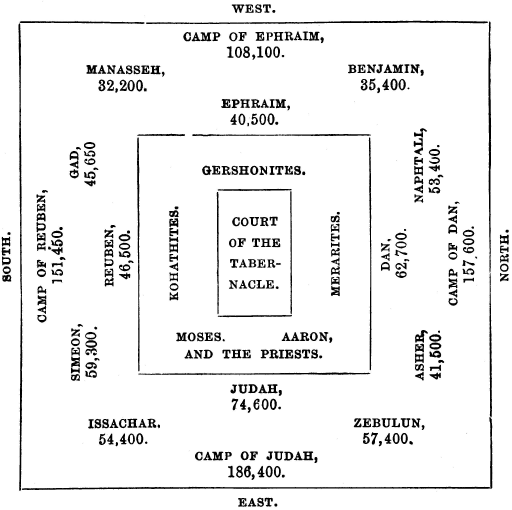
The order in which the tribes were to march was also specified. In Ps. 80:2 we read "Before Ephraim, and Benjamin, and Manasseh, stir up thy strength, and come and save us." This alludes to those three being the tribes which immediately followed the Ark, the symbol of God's presence. It will be seen that the tribes were grouped under four leaders, each being called a camp. They moved in the order given in Num. 10.
JUDAH, with Issachar and Zebulun,
The GERSHONITES and the MERARITES with the Tabernacle,
REUBEN, with Simeon and Gad,
The KOHATHITES with the 'sanctuary,'
EPHRAIM, with Manasseh and Benjamin,
DAN, with Asher and Naphtali.
Certain defilements shut a person out of the camp until he was cleansed, and many things had to be carried outside as being unfit for the place in the midst of which God had His dwelling-place. When the camp itself had become defiled by the golden calf, Moses "took the tabernacle and pitched it without the camp . . . . and called it the tabernacle of the congregation." This was not really 'the tabernacle,' for it had not at that time been erected. The word used signifies 'the tent,' and it was doubtless a tent anticipatory of the tabernacle significantly pitched by Moses outside the camp, to show that God's dwelling could not be where there was an idol, for it is added, "Every one which sought the Lord went out unto the tabernacle of the congregation, which was without the camp." Ex. 33:7.
The bodies of the beasts whose blood was brought into the sanctuary by the high priests for sin were burned without the camp. Ex. 29:14; Lev. 4:11-12; Heb. 13:11. With this is linked the fact that Jesus also 'suffered without the gate' (of Jerusalem, which then answered to the camp); on which is based the exhortation to Christians, "Let us go forth therefore unto him without the camp, bearing his reproach." Heb. 13:12-13. The whole earthly religious system adapted to the natural man, as Judaism of old, answers now to 'the camp' which Christians are exhorted to leave. Such systems, Judaism and Christendom, stand in direct contrast to the heavenly and spiritual character of the church of God. The camp in Rev. 20:9 refers to the nation of Israel when again gathered into the land of Palestine. There is no 'camp' on earth for the church.
Camphire.
A shrub whose flowers grow in bunches having a very sweet smell. Cant. 1:14; Cant. 4:13. The Hebrew name is kopher, and the Arabs call it henna. A powder made of the leaves and flowers is mixed with water and used by the women to colour the nails of their hands and feet.
Cana of Galilee. [Ca'na ]
The scene of the Lord's first miracle and of His second in Galilee: the native place of Nathanael. John 2:1, 11; John 4:46; John 21:2. There is nothing in these passages to tell where Cana was situated except that it was in the neighbourhood of Capernaum and on higher ground. It is identified by most with Kefr Kenna, 32 45' N, 35 20' E, but others prefer Kana el Jelil, about 8 miles north of Nazareth, the name of which more resembles Cana.
Canaan. [Ca'naan]
Son of Ham and grandson of Noah. Gen. 9:18-27. Of Canaan Noah said, "Cursed be Canaan; a servant of servants shall he be unto his brethren," and then is added that he shall be the servant of Shem and of Japheth. It may seem strange that Noah did not curse Ham personally who had not respected his father; but doubtless it was God who, in His government, led Noah, in giving forth the prophecy respecting his three sons in the new world, to visit the conduct of Ham upon his son. God had already blessed Ham along with Noah and had made a covenant with him, how then could he lead Noah to curse him? Gen. 9:1, 8. Besides, we do not find that all Ham's sons became the servants of Shem; upon Canaan only the curse fell. It was Nimrod, Ham's descendant, who founded the great kingdoms of the East, and we do not read of them being tributary to Israel as Canaan was. God, in the wisdom of His government, led Noah to pronounce the curse upon Canaan, in strong contrast with the blessing of Jehovah upon Shem, which was fulfilled in Israel.
Canaan, Land of. [Ca'naan]
The land possessed by the descendants of Canaan, the son of Ham, which was until recently called PALESTINE. The whole of it was promised to Abraham, and a further territory was also promised 'from the river of Egypt unto the great river, the river Euphrates.' Gen. 15:18; Gen. 17:8. The word used here thrice for 'river' is nahar, which is not applicable to a winter stream, so that 'river of Egypt' doubtless refers to the most easterly branch of the Nile, called Pelusiac. These limits of Abraham's promised possession are on the S.W. and N.E.; the Mediterranean being the western limit, the eastern being undefined; but the 'river Euphrates' boundary must be on the north part of that river, which indeed was reached by Solomon at Tiphsah (about 35 50' N, 39 E). 1 Kings 4:24.
In Num. 34:5-8 directions are given as to the boundaries of the land to be then possessed by the tribes, and here a different word is used for 'river' (nachal) in 'river of Egypt.' This word signifies 'brook in a valley,' and cannot refer to the Nile; indeed the places also mentioned are more in the latitude of the wady called el Arish, 31 5' N, 33 50 E near to the ancient city Rhinocolura. This is not so far south as the country over which Solomon had dominion, which extended to Ezion-geber on the gulf of Akaba. In Num. 34:9-11 the north border is also given, and though some of the places cannot be traced, it is yet clear that the border did not extend as far as was possessed under Solomon, who anticipated for the moment the possession which will yet be inherited by Israel under Christ. 'From Dan to Beersheba' became the common way of describing the whole of Canaan. This comprised about 150 miles from north to south. In Deut. 1:7 the borders are named as between 'the mount of the Amorites,' near the Dead Sea on the south, to 'Lebanon and the river Euphrates' on the north.
The land is declared to be like no other country on earth, presenting as it does in so small a compass such diversity of surface; some parts being fruitful plains; other parts rugged rocks and spacious caves, and mountains with their sides covered with vineyards. One part is 1200 feet below the level of the sea, with a tropical atmosphere; its highest part 9000 feet above the sea, with an Alpine temperature. In some places it is a garden of flowers; in others an arid desert. See SEASONS.
The land of Canaan may be described as having four zones: by the Mediterranean Sea a plain runs from north to south, much wider in the south than in the north; it is broken into by Mount Carmel running across it. Parallel with the plain is a zone of hill country from Lebanon to the south, varying in height, and with some mountains. To the east of this is the valley in which runs the Jordan with the Sea of Galilee and the Dead Sea. To the east of the Jordan valley is another range of hill country, which declines into the desert on its east. In the west, south of Aijalon, 31 51' N, 35 1' E, is a district called the Shephelah. It is distinct from the plain by the sea coast, and distinct from the hill country. It is sometimes described as low hills or 'the lowland.' It was the part where the Israelites were so often attacked by the Philistines.
God Himself describes the land as "a land of brooks of water, of fountains and depths that spring out of valleys and hills; a land of wheat, and barley, and vines, and fig trees, and pomegranates; a land of oil olive and honey; a land wherein thou shalt eat bread without scarceness, thou shalt not lack anything in it; a land whose stones are iron, and out of whose hills thou mayest dig brass." Deut. 8:7-9. Universal testimony is given to the great productiveness of the soil if it were properly cultivated; but under the judgement of God and the misrule of man comparatively little has been produced until the State of Israel was founded in the twentieth century.
Ruins of former greatness abound everywhere showing how the judgements predicted by God have been fulfilled; but it is well to remember that the predictions as to future blessing will as certainly be fulfilled as were those as to judgements. It will yet be 'the holy land,' Zech. 2:12; 'Immanuel's land,' Isa. 8:8; for it is 'the land of promise,' Heb. 11:9. It is called CHANAAN in Acts 7:11; Acts 13:19.
It is estimated that there are now 4.8 million Jews in Israel [AD2000], many are resorting thither, but, alas, in unbelief. There were only 100,000, 100 years ago. There are other ethnic groups in Israel, as well as Gaza and Jordan, particularly Palestinian Muslims who were defeated by Israel in the war of 1948. The Palestinians number about 3.6 million of which 0.9 million are in Israel itself.
The name Palestine is often now used as synonymous with Canaan, but in the scripture that term and 'Palestina' refer to the land of the Philistines, the narrow border on the sea coast in the south of Canaan. Ex. 15:14; Isa. 14:29, 31; Joel 3:4.
The land on the west of the Jordan and some portions on the east have been surveyed, firstly by the officers of the Palestine Exploration Fund, which has been the means, as far as their judgement goes, of identifying many Biblical sites. Their map enabled the longitude and latitude of the principal places being given in this work. The modern State of Israel has ensured that much is now known of the geography of the country.
Canaanites, The. [Ca'naanites ]
The descendants of Canaan the son of Ham, of whom the Jubusites, the Amorites, the Girgashites, the Hivites, the Arkites, the Sinites, the Arvadites, the Zemarites, and the Hamathites were branches. They were "spread abroad, and the border of the Canaanites was from Sidon, as thou comest to Gerar, unto Gaza: as thou goest unto Sodom and Gomorrha, and Admah, and Zeboim, even unto Lasha." Gen. 10:15-19. In Gen. 15:18-21, where the land promised to Abram extends to the river Euphrates, there are ten nations mentioned: the Kenites, the Kenizzites, the Kadmonites, the Hittites, the Perizzites, the Rephaims, the Amorites, the Canaanites, the Girgashites, and the Jebusites. Deut. 7:1; Joshua 3:10. Here and elsewhere the Canaanites are only one people of many; whereas in other places the term Canaanite appears to include any of the inhabitants of Canaan, as in Joshua 17:12-13; Neh. 9:24; Obadiah 20; Zech. 14:21. The same Hebrew word is translated 'merchant' in Job 41:6; Prov. 31:24; Isa. 23:8; so the passage in Zech. 14:21 may signify "there shall no more be the merchant in the house of the Lord of hosts." cf. John 2:16.
Canaanite, The. [Ca'naanite]
Used to designate Simon Zelotes, one of the twelve apostles; this name Κανανίτης, Canaanite, is not the same as that of an inhabitant of Canaan, which in the LXX is Καναναῖος. That respecting Simon occurs in Matt. 10:4; Mark 3:18; by the other two Evangelists he is styled 'Zelotes,' and Κανανίτης (in some copies Καναναῖος) is held to be from the Aramaic qana, 'to be zealous:' cf. Num. 25:11, 13.
Candace. [Can'dace]
Name or title of a queen of the Ethiopians, whose eunuch was converted on his returning from a visit to Jerusalem. Acts 8:27.
Candle.
Used in the O.T. for any light either real or symbolical. Job said of God, "when his candle shined upon my head," Job 29:3; "the candle of the wicked shall be put out," Prov. 24:20; whereas respecting 'the wise woman' it is said "her candle goeth not out by night." Prov. 31:18. God will search Jerusalem with candles. Zeph. 1:12. In the N.T. the word signifies a lamp, and in some passages is typical of the testimony of God, which should be manifested in those receiving it, and should not be hidden. Luke 8:16; Luke 11:33, 36; etc. In the holy Jerusalem there will be no need of the candle of earthly light, for the Lord God shall shine upon them. Rev. 22:5. The modern 'candle' was not known in scripture times.
Candlestick.
This, in scripture, signifies a lamp-stand, as is plainly implied in 2 Chr. 4:20: 'the candlesticks with their lamps,' used in the temple. A 'candlestick' is also mentioned in Belshazzar's palace, near which the fingers of a man's hand wrote upon the wall. Dan. 5:5. Except in large buildings, hand lamps were all that were needed.
THE GOLDEN CANDLESTICK in the Tabernacle and Temple with its seven lamps is minutely described in Ex. 25:31-40: it is also called the 'pure candlestick.' It was situate in the holy place, and gave light over against the table of showbread. It might be thought from Ex. 27:20 that the lamps were to be kept alight always, but this does not appear to be the sense of 'burn always.' It should rather be read 'burn continuously,' that is, every evening, for in the next verse it adds 'from evening to morning;' and in Ex. 30:8 it distinctly says "when Aaron lighteth the lamps at even." In the morning they were allowed to go out. 1 Sam. 3:3: cf. also 2 Chr. 13:11. The candlestick was entirely of gold, signifying that which was divine in its nature, and was typical of Christ the true light, but to be reproduced in His people. Eph. 5:8. The number of the lamps (seven) is also indicative of divine perfection.
The Candlestick that was in the temple in the time of the Lord was carried away at the siege of Jerusalem, and is portrayed on the triumphal 'Arch of Titus' at Rome, but as fabulous animals are depicted on its base it is very questionable whether it is a true representation.
Cane, Sweet.
One of the ingredients of the holy anointing oil. The Hebrew word qaneh, and is and is three times translated 'calamus.' God lamented that Israel did not buy any sweet cane for Him, Isa. 43:24; and when they did bring it from afar, it was no longer sweet to Him because of their waywardness and sin. Jer. 6:20.
Canker,
γάγγραινα. The word of those who err from the truth eats like a 'gangrene' which consumes the flesh. Such teaching saps the vitals of Christianity. 2 Tim. 2:17.
Cankered,
κατιόομαι. The gold and silver of the rich who have oppressed the poor is 'rusted,' and the 'rust' thereof shall be a witness against them. James 5:3.
Cankerworm,
yeleq. This is supposed to be the 'hedge-chafer,' a species of locust. It "spoileth [or spreadeth itself out] and fleeth away." It devours much herbage, and is used as a figure of the enemies that would destroy Nineveh. Nahum 3:15-16; Joel 1:4; Joel 2:25. The same Hebrew word is translated CATERPILLER in Ps. 105:34; Jer. 51:14, 27.
Canneh. [Can'neh]
City of the East which traded with Tyre. Ezek. 27:23. Perhaps the same as CALNEH.
Canon of Scripture.
The word κανών signified a rod or rule by which things were tested. It is thus used by Paul in Gal. 6:16; Phil. 3:16. As to the scriptures the expression refers to what books should be included: thus the 'canon' of scripture is often spoken of, and the books are called 'canonical' or 'uncanonical.' Happily most Christians are not troubled with such questions. In christian simplicity they believe that in the Bible they have nothing but what God caused to be written, and that it contains all that He intended to form a part of His book. Still, as everything is now challenged it may be well to examine the subject a little.
In the first place, the Church of Rome boldly declared that it was only 'the church' that could decide what books were canonical: as early as the Council of Carthage (about A.D. 400) lists of the books were made out, and at the Council of Trent they dogmatically settled what books constituted the scripture. They decided to include the books now known as the APOCRYPHA (q.v.), as may be seen in the Latin Vulgate, which is the version used by that church. Now the scripture informs us that to the Jews were committed the oracles of God, Rom. 3:2, and as is well known they most carefully guarded the O.T. scriptures for centuries before there was any christian church. The books were written in the Jews' language — the Hebrew — with which the Apocrypha never had a place. They were written in Greek, and were first added to the LXX. The above principle — that the scriptures require to be accredited by the church — is false. Surely God could make a revelation that would in no wise need to have the seal of a body of men placed upon it, be they ever so holy. But the Church of Rome was not holy, nor was it universal, so that even if the alleged principle were correct, that corrupt section of the church would be the last to be taken as an authoritative guide.
The N.T. has also had its perils. With the Greek MSS apocryphal books are found, parts of which were read in the churches in early days. Later on several of the Fathers of the church so called had their doubts respecting some of the Epistles. Even as late as the Reformers it was the same. Luther spoke disrespectfully of the Hebrews, James, Jude, and the Revelation, and set them apart at the end of his version. Calvin doubted the authenticity of James, 2 Peter, and Jude. In modern times many portions of books in the O.T. and N.T. are being called in question. But the Bible needs not to be accredited by man. It carries its own credentials to the heart and conscience of the Christian in the power of the Holy Spirit. The natural man is not competent to judge of such a question. The Bible has the stamp of God upon it, and the more it is studied by the Christian the more perfect it is found to be — no part redundant, and no part lacking.
Canticles.
See SONG OF SOLOMON.
Capernaum. [Caper'naum]
Remarkable as being called the Lord's 'own city. Matt. 9:1; Mark 2:1. It was one which He often visited, and in which many of His 'mighty works' were done. He speaks of it as 'exalted to heaven;' perhaps in the privilege of the presence and testimony of the Lord; but, because of refusing Him and His works, it should be 'brought down to hell' (Hades). Matt. 11:23. It has been so destroyed that even its ruins cannot with certainty be discovered. It was in the district of Gennesaret (Matt. 14:34; John 6:17, 24), therefore on the N.W. of the Sea of Galilee. Its identification varies between Khan Minia, 32 52' N, 35 34' Eand Tell Hum, about 3 miles farther N.E. There are ruins or rather mounds in both places, and the relics of a synagogue at the latter, but a fountain of water, of which Josephus speaks, is only found at Khan Minia.
Caphtor. [Caph'tor]
The country from which, beside the Caphtorim, came some of the Philistines. They sprang from Mizraim, son of Ham. Deut. 2:23; Amos 9:7. In Jer. 47:4 the 'isles,' margin, may only signify 'maritime border.' Caphtor is supposed to be somewhere in Egypt, but has not been identified. See CASLUHIM
Caphtorim. [Caphto'rim]
The people of Caphtor. Gen. 10:14; Deut. 2:23; 1 Ch 1:12.
Cappadocia. [Cappado'cia]
District in the east of Asia Minor. Visitors from thence were at Jerusalem at the feast of Pentecost, and Peter includes this district when he addresses his first Epistle to the dispersed Jews. Acts 2:9; 1 Peter 1:1. The district extended as far eastward as the Euphrates.
Captain.
In the O.T. this word is used for one filling any office of rule or command: as the head of a tribe, Num. 2:3-29; commander of an army, etc. The person who appeared to Joshua as 'a man' declared himself to be 'captain of the Lord's host.' He told Joshua to remove his shoes from his feet, for the ground was holy, evincing that he was God's representative to lead their warfare. Joshua 5:14-15. In the N.T. the Lord is called 'Captain' of our salvation, ἀρχηγός, 'chief leader.' Heb. 2:10.
There was also a 'CAPTAIN OF THE TEMPLE,' στρατηγός. Luke 22:4, 52; Acts 4:1; Acts 5:24, 26. This word is literally 'the leader of an army;' it is also applied to magistrates, Acts 16:20, but the captain of the temple was set not over the soldiers, but over the priests and Levites: cf. Num. 3:32; 1 Chr. 9:11; Jer. 20:1.
THE CHIEF CAPTAIN or HIGH CAPTAIN is χιλίαρχος, lit. 'Captain of a thousand,' applied to the chief of the soldiers in Jerusalem. Acts 21 - 25.
CAPTAIN OF THE GUARD, Acts 28:16, is στρατοπεδάρχης, properly 'commander of a camp,' but here the prefect of the Praetorian Guard, an officer to whom state prisoners were entrusted at Rome.
Captivity.
This principally refers in the O.T. to the 'carrying away' of Israel and Judah. The order in which Israel was carried into captivity is not very clear. It appears however that the events recorded in 1 Chr. 5:26 occurred first, because of Pul king of Assyria being mentioned, for he reigned before Tiglath-pileser: here the latter is named as carrying away the Reubenites, the Gadites, and the half tribe of Manasseh: showing that the Israelites who stopped short of their privileges, and did not cross the Jordan, were the first to be carried into captivity. There is nothing in the passage to fix the date, but in 2 Kings 15:29 is another reference to Israel when Tiglath-pileser took Ijon, Abel-beth-maachah, Janoah, Kedesh, and Hazor, which are all in the north on the west of the Jordan; but then is added Gilead, which is on the east, and this may be intended to embrace the two and a half tribes; then Galilee with all the land of Naphtali is added, which is again in the north on the west. So that this may be a summary of all that this king carried away captive to Assyria. It was 'in the days of Pekah,' and Pekah reigned 20 years: the date is generally reckoned as B.C. 740 for the captivity of the two and a half tribes.
A more definite date is given for the captivity of the remaining portion of Israel in 2 Kings 18:10-11. It was in the ninth year of Hoshea, king of Israel and the sixth of Hezekiah that Samaria was taken by the Assyrians after a three years' siege: this would be B.C. 722. The captives were carried to Halah and Habor by the river of Gozan (these same names being mentioned in 1 Chr. 5:26, with Hara added there). These places are supposed to be in the north of Assyria; but in the above passage in Kings the words are added "and in the cities of the Medes." This is a region much farther east, where they would be far removed from their brethren in Assyria and from Judah, who were afterwards carried to Babylon.
The captivity of Judah followed in four detachments. Nebuchadnezzar, B.C. 606, carried away the sacred vessels and captives, among whom were Daniel and his companions. This formed the commencement of the 'times of the Gentiles.' 2 Chr. 36:6-7. The second captivity was in B.C. 599, when Jehoiachin had reigned three months. It is called the great captivity. Zedekiah was left as a vassal of Babylon. 2 Kings 24:14; 2 Chr. 36:10. The third captivity was in B.C. 588. 2 Chr. 36:20. The fourth was in B.C. 584 under Nebuzar-adan. Jer. 52:12, 30. The 70 years of captivity foretold by Jeremiah (Jer. 25:11-12) commenced B.C. 606 and expired B.C. 536 when the Jews returned to Judaea by the proclamation of Cyrus king of Persia. Jer. 29:10; Ezra 1. The captivity is referred to in Matt. 1:11, 17 as 'the carrying away.' The places to which Israel and Judah were carried are considered under their respective names.
Those who returned from exile were the two tribes, Judah and Benjamin (unless any few of the ten tribes may have accompanied them; cf. Luke 2:36). They retained possession of the land, under many changes and vicissitudes, until their Messiah appeared. His rejection and crucifixion resulted in the destruction of Jerusalem by the Romans A.D. 70, and the scattering of the Jews to all parts of the world.
Carbuncle.
Two Hebrew words are so translated.
1. eqdach, a stone of a fiery sparkling nature. Isa. 54:12.
2. bareqeth, a stone of a glittering brightness. Ex. 28:17; Ex. 39:10; Ezek. 28:13.
Carcas. [Car'cas]
Chamberlain of Ahasuerus. Esther 1:10.
Carchemish. [Carche'mish]
City on the river Euphrates, about 36 50' N, 38 5' E. The Assyrian monuments show that about 1,000 years B.C. it belonged to the Hittites. Apparently it was taken by the Assyrians, Isa. 10:5, 9; afterwards conquered by Necho king of Egypt, after the battle of Megiddo, in which Josiah was killed, 2 Chr. 35:20, where it is CHARCHEMISH. Three years later it was taken by Nebuchadnezzar. Jer. 46:2. Carchemish has often been associated with the classical Circesium, and placed on maps some 200 miles S.E. of the above, which is judged to be an error.
Careah. [Care'ah]
See KAREAH.
Carmel. [Car'mel]
1. This name has generally the article, and signifies 'the park' or fruitful place. A mountain 12 miles in length that runs from the plain of Esdraelon in Galilee, in a N.W. direction toward the Mediterranean, where it forms a notable promontory, the only one in Palestine. It was the scene of Elijah's contest with the priests of Baal, that led to their destruction. 1 Kings 18:19-40. One part towards its east end is still called Mukrakah, 'place of burning,' the traditional spot of the above encounter. There Elijah repaired the altar of the Lord: this may have been erected before the temple was built, and been broken down, but its moral bearing is obvious. God vindicated His servant, and answered by fire from heaven. A perennial well near by would, notwithstanding the drought, have supplied the water Elijah needed. The spot is about 1,600 feet above the sea, and Elijah's servant had to go but a short distance to have the Mediterranean in view and to watch for a cloud.
The mountain was afterwards the residence of Elisha, where he was visited by the Shunammite woman on the death of her child. 2 Kings 4:25. It is well wooded with shrubberies and brushwood, Isa. 33:9; Micah 7:14, and is beautiful with the multitude of its flowers, in fact the spot is declared to be even now the fragrant lovely mountain as of old. In Cant. 7:5 the head of the bride is compared to Carmel. It is now called Jebel Kurmul.
2. City in the hill-country of Judah, Joshua 15:55, the abode of Nabal and Abigail the Carmelitess. 1 Sam. 25:2-40. Identified with el Kurmul, 31 26' N, 35 8' E. It is probable that 1 Sam. 15:12 refers to this city; also 2 Chr. 26:10, unless the word there is translated 'fruitful fields,' as in the margin and R.V. All other passages refer to No. 1.
Carmelite, [Car'melite] Carmelitess. [Car'melitess]
Inhabitants of Carmel. 1 Sam. 27:3; 2 Sam. 23:35; 1 Chr. 3:1; 1 Chr. 11:37.
Carmi. [Car'mi]
1. Father of Achan, a. descendant of Judah. Joshua 7:1, 18; 1 Chr. 2:7; 1 Chr. 4:1.
2. Son of Reuben and progenitor of the family of the CARMITES. Gen. 46:9; Ex. 6:14; Num. 26:6; 1 Chr. 5:3.
Carnal.
See FLESHLY.
Carpenter.
Of interest to the Christian in that the Lord was not only called 'the carpenter's son,' but also 'the carpenter,' Matt. 13:55; Mark 6:3, which implies that He actually worked as an artizan before He began His heavenly Father's 'business,' for which He specially came into the world. It demonstrates the real manhood He had taken in grace.
Carpus. [Car'pus]
One at Troas with whom Paul left a cloak. 2 Tim. 4:13.
Carriage.
This does not appear to be ever used in the scriptures in the modern sense of the word, but signifies 'the thing carried,' 'baggage.' Judges 18:21; 1 Sam. 17:22; Isa. 10:28; Acts 21:15. The meaning in Isa. 46:1 is probably that the idols which were once 'carried' with joy in festal processions (cf. Amos 5:26) are now 'lifted up as loads' to be carried on beasts of burden.
Carrying away.
Matt. 1:17. See CAPTIVITY.
Carshena. [Car'shena]
One of the seven princes of Persia and Media. Esther 1:14.
Cart.
The vehicle on which the Philistines sent back the Ark. David in error also used a 'new cart' to fetch it from Gibeah: a human arrangement which displeased the Lord. 1 Sam. 6; 2 Sam. 6:3. The same word, agalah, is translated 'wagons,' which were sent from Egypt to bring Jacob and his family, Gen. 45:19; and used for the carrying of parts of the tabernacle, Num. 7:3, where they are called 'covered wagons,' but which some prefer to call 'litter-wagons.' On the Egyptian and Ninevite monuments many carts are portrayed with two wheels, and some of the wheels were made with spokes.
Carved Work.
This was much used in the Temple. "He carved all the walls of the house round about with carved figures of cherubim, and palm-trees, and open flowers." They were then overlaid with gold. 1 Kings 6:18, 29-35. The Psalmist prophetically laments its being broken down by the enemy with axes and hammers. Ps. 74:6. For the 'carved images' of idolatry, Judges 18:18; 2 Chr. 33:7, 22; 2 Chr. 34:3-4, another word is used, which is elsewhere translated 'graven image.'
Casement.
A lattice window for the admission of air. Prov. 7:6.
Casiphia. [Casiph'ia]
Place between Babylon and Jerusalem, where Iddo resided: otherwise unknown. Ezra 8:17.
Casluhim. [Cas'luhim]
People who descended from Mizraim, and 'out of whom came Philistim' or the Philistines (some of the Philistines: see CAPHTOR). Gen. 10:14; 1 Chr. 1:12.
Cassia.
The bark of an aromatic plant resembling, cinnamon, the Arabian cassia. It was used in the holy anointing oil; and, with myrrh and aloes, will perfume the garments of Christ as King. It was one of the articles of merchandise of Tyre. Ex. 30:24; Ps. 45:8; Ezek. 27:19.
Castaway,
ἀδόκιμος. Paul kept his body under control, lest, though he had preached to others, he himself should be a castaway. 1 Cor. 9:27. The same word is translated 'reprobate' in Rom. 1:28; 2 Cor. 13:5-7; 2 Tim. 3:8; Titus 1:16; and 'rejected' in Heb. 6:8. It is the negative form of 'approved,' Rom. 16:10; etc.
Castle.
See FORTRESS.
Castor and Pollux.
The word Διόσκουροι signifies 'young men, or sons of Zeus,' their names being Castor and Pollux according to heathen mythology. They were supposed to be the guardians of navigation, and a rude image of them was at times carved on the bows of vessels. Acts 28:11.
Caterpiller.
The word chasil signifies 'devourer,' hence the name of a species of locust. 1 Kings 8:37; 2 Chr. 6:28; Ps. 78:46; Isa. 33:4; Joel 1:4; Joel 2:25. In Ps. 105:34; Jer. 51:14, 27 the word is yeleq, and is elsewhere translated CANKERWORM, q.v.
Catholic Epistles.
A name often given to the Epistles of James, 1 and 2 Peter, 1 John, and Jude, and which are called 'general' epistles in the A.V., doubtless because of not being addressed to any particular person or assembly. The word 'catholic' occurs in a few Greek MSS, but not in any of the most ancient ones.
Cattle.
Various Hebrew words are used in reference to the cow and the ox as 'cattle.' The word miqneh, however, often used for 'cattle,' signifies 'possession,' because the principal property of nomadic tribes consisted of their cattle: the word includes also sheep and goats, but not horses and asses. Ex. 9:3-21, etc. Another word, tson, signifies small cattle, that is, sheep and goats. Gen. 30:39-43; Gen. 31:8-43; Ecc. 2:7. seh has the same meaning, Gen. 30:32; Ezek. 34:17-22: in Isa. 7:25 it is translated 'lesser cattle,' and in Isa. 43:23 'small cattle.'
Caul.
The diaphragm or midriff, which stretches above the liver all across the thorax. Ex. 29:13, 22; Lev. 3:4, 10, 15; Lev. 4:9; Lev. 7:4; Lev. 8:16, 25; Lev. 9:10, 19. In Hosea 13:8 it is the pericardium, that which encloses the heart.
Cauls.
Caps of net-work. Isa. 3:18.
Causeway.
A 'way cast up,' more often translated 'highway.' 1 Chr. 26:16, 18.
Caves.
Palestine is remarkable for its number of caves, some of which are of great extent. David and his followers were in a cave in the wilderness of En-gedi, so extensive that they could hide themselves, though Saul came into the same cave. 1 Sam. 24:1-8: cf. Heb. 11:38. The Adullam cave and others also are of note in the O.T. The tomb of Lazarus was a cave. John 11:38.
Cedar.
The beautiful tall tree that was extensively used by Solomon in building the temple and his palaces. It is called 'cedar' from the firmness of its roots; its wood is very durable and odoriferous. It was used for beams, pillars and masts, and for carved images. 1 Kings 6:9-10; Isa. 44:14; Ezek. 27:5. Special reference is made to it in scripture, as "the trees of the Lord are full of sap; the cedars of Lebanon which he hath planted." Ps. 104:16. It cannot be considered as one of the trees of Palestine proper, but is constantly connected in scripture with Lebanon, where it still grows in a group of some 300, a few being very old, and with no others near: the neighbouring people regard them with reverence.
In the cleansing of the leper, and in connection with burning the Red Heifer, cedar wood and hyssop were used, typical of the highest and the lowest (the judgement of death upon all men and the whole fashion of this world). Lev. 14:4-52; Num. 19:6. The cedar is used as a symbol of strength and stability: the righteous shall grow up as a cedar of Lebanon. Ps. 92:12. The Assyrian king in his strength was also compared to a cedar, which is thus described: "with fair branches, and with a shadowing shroud, and of an high stature," Ezek. 31:3; for his pride he was to be brought down.
Cedron.
See KIDRON,
Ceiled, Ceiling.
The covering a roof of a room with wood, formed into patterns: some with fir-trees as 2 Chr. 3:5, and others with cedar and painted. 1 Kings 6:15; Jer. 22:14; Ezek. 41:16; Hag. 1:4.
Cenchrea. [Cen'chrea]
Eastern sea-port of Corinth, from which it was distant 9 miles. Paul once sailed from thence, and a church was formed there. Acts 18:18; Rom. 16:1. The modern village has a similar name, Kekhries.
Censer.
A small vessel made of metal, to contain burning coals from the altar, on which incense was sprinkled by the priest, that a cloud of incense might arise therefrom. Lev. 10:1; Lev. 16:12. Solomon made some of gold. 1 Kings 7:50; 2 Chr. 4:22; Heb. 9:4; Rev. 8:3, 5. The same word is used when the company of Korah, Dathan, and Abiram were put to the test; the censers were probably hastily constructed ones, for 250 were needed. Aaron ran with a censer and incense between the living and the dead, and the plague was stayed. Num. 16:6-48. The same Hebrew word is translated 'fire-pan' in Ex. 27:3; Ex. 38:3; 2 Kings 25:15; Jer. 52:19.
Census.
It was a part of the Mosaic law that when the people were numbered, every one, from twenty years old and upwards should give unto the Lord a half shekel as a ransom for his soul, that there might be no plague among them. Ex. 30:11-16; Ex. 38:25-26. The numbering was an opportunity when flesh might exalt itself as to their numbers collectively, as well as each individual being noticed. But there was to be the recognition that it could only be on the ground of redemption that they could be taken into account by Jehovah. They must be reminded that they belonged to God, Deut. 7:6, and must pay a ransom each one for himself.
A census of Israel was taken several times. It comprised the males from twenty years old and upwards, able to go to war.
1. At Sinai in the second month of the second year when they declared their pedigree after their families; there were 603,550, Ex. 38:26; Num. 1:1-46 (stated in round numbers as 600,000 in Exodus 12:37). The Levites from a month old were 22,000. These were taken for the tabernacle service as a redemption for the first-born of Israel whom God claimed; but of the latter there were 273 more than of the Levites, therefore the 273 were redeemed at 5 shekels each. Num. 3:39-51.
2. On the plains of Moab, 38 years after, when the number was 601,730, the numbering at that time being needed for the division of the land. The Levites numbered 23,000. Num. 26:51, 62.
3. By David, when there was no need for it, he being moved to it by Satan (being permitted by God, 2 Sam. 24:1), and which called down the judgement of God on his pride. In 2 Sam. 24:9 the number is 1,300,000; but in 1 Chr. 21:5 it is 1,570,000. We read that Joab did not finish the numbering of the people "because there fell wrath for it against Israel," 1 Chr. 27:24: so that the number in Samuel may be of those actually counted, and that in Chronicles may include an estimate of the districts not canvassed. It is added "neither was the number put in the account of the chronicles of king David." If the above numbers be multiplied by 3.3 the result will give approximately the number of the population.
4. By Solomon, of the strangers that were in the land: they amounted to 153,600. 2 Chr. 2:17-18.
5. Of those who returned from captivity: there were 42,360. Ezra 2:64. In Ezra 8:1-20, 1,754 males are also recorded.
In the N.T. the 'taxing' under Cyrenius is generally held to be a census: the word is ἀπογραφή, an enrolment or register. Florus the Roman historian says, that a census comprised "every one's estate, dignity, age, employment, and office;" this occasion may therefore have been only a preliminary to taxing. The Jews were apparently allowed to conduct the census in their own way as to lineage. It has been proved that Cyrenius (Quirinius) was twice governor of Syria, which removes all difficulty as to the date of the census in Luke 2:1-5. The same Greek word is translated 'taxing' in Acts 5:37, when Judas headed an insurrection.