Bible Dictionary H 1
Hazael. [Haza'el]
King of Syria. When an officer of Ben-hadad, he was sent to Elisha (who was visiting Damascus) to know whether Ben-hadad should recover of his sickness. Elisha's answer was indefinite: "Go, say unto him, Thou mayest certainly recover: howbeit the Lord hath showed me that he shall surely die." Elisha then wept and explained it was in view of the cruelty that Hazael would do to Israel. Hazael repudiated this imputation, whereupon Elisha told him that he would be king over Syria. Elijah had been bidden to anoint Hazael as king of Syria, but we do not read that he ever anointed him, neither is there any word of Elisha's doing this on the above occasion. Hazael returned to his master and told him that the message was that he should surely recover; but the next day he smothered him and reigned in his stead.
For some time Hazael was attacked by Assyria, and his kingdom suffered severely; but when these hostilities ceased, he turned his arms against Israel, and was the instrument God used to punish His guilty people, and 'to cut Israel short.' Hazael smote all the coasts of Israel. This antagonism he continued to the end of his life. From time to time God gave His people relief, but they turned not from their evil ways, and the oppression was renewed with varying success by Hazael's son, Ben-hadad III. 2 Kings 19:15, 17; 2 Kings 8:8-29; 2 Kings 9:14-15; 2 Kings 10:32; 2 Kings 12:17-18; 2 Kings 13:3, 22-25; 2 Chr. 22:5-6; Amos 1:4. The name of Hazael has been identified on one of the obelisks of Assyria.
Hazaiah. [Hazai'ah]
Son of Adaiah, of the tribe of Judah. Neh. 11:5.
Hazaraddar. [Hazar'-ad'dar]
A southern boundary of Palestine. Num. 34:4. Called ADAR in Joshua 15:3. Not identified.
Hazarenan. [Hazar'-e'nan]
The N.E. boundary of the promised land both in the past and in the future. Num. 34:9-10; Ezek. 47:17; Ezek. 48:1. Mr. Porter has identified it with Kuryetein, about sixty miles E.N.E. of Damascus, where there are copious fountains, which 'Enan' seems to imply.
Hazargaddah. [Hazar'-gad'dah]
Town in the south of Judah. Joshua 15:27. Not identified.
Hazarhatticon. [Ha'zar-hatti'con]
Place connected with the N.E. boundary of the land in Ezekiel. It reads the 'middle village' in the margin. Ezek. 47:16. Not identified.
Hazarmaveth. [Hazarma'veth]
One of the sons of Joktan, a descendant of Shem. Gen. 10:26; 1 Chr. 1:20. The name is supposed to have been preserved by the settlement of the tribe in Hadramaut, in the far south of Arabia, about 16 10' N, 50 E.
Hazarshual. [Hazar'-shu'al]
Town in the south of Judah. Joshua 15:28; Joshua 19:3; 1 Chr. 4:28; Neh. 11:27. Not identified.
Hazarsusah, [Hazar'-su'sah] or Hazarsusim. [Hazar'-susim]
City in the extreme south of Judah, allotted to Simeon. Joshua 19:5; 1 Chr. 4:31. The names signify 'village of horses,' and it may have been a depot for horses from Egypt.
Hazazontamar. [Ha'zazon-ta'mar]
See HAZEZON-TAMAR.
Hazel. [Ha'zel]
The word is luz, which is now thought to refer to the 'almond,' and is so translated in the R.V. Gen. 30:37.
Hazelelponi. [Hazelelpo'ni]
A woman of the tribe of Judah. 1 Chr. 4:3.
Hazerim. [Haze'rim]
This may refer to a district in the S.W. of Palestine, or to the temporary dwellings of the Avim before they were expelled by the Caphtorim. Deut. 2:23. The R.V. and others translate it 'hamlets' or 'villages.'
Hazeroth. [Haze'roth]
Station of the Israelites in the wilderness. Num. 11:35; Num. 12:16; Num. 33:17-18; Deut. 1:1. Identified by some with Ain Hudherah, 28 55' N, 34 30' E.
Hazezontamar. [Ha'zezon-ta'mar]
Same as En-gedi. Gen. 14:7. It is HAZAZONTAMAR in 2 Chr. 20:2.
Haziel. [Hazi'el]
Son of Shimei, a Gershonite. 1 Chr. 23:9.
Hazo. [Hazo']
Son of Nahor and Milcah: the location of his descendants is not known. Gen. 22:22. The name of Ha-zu-u (Hazu) has been found in the Assyrian inscriptions, which are thought to point out the settlement of Hazo to be on the borders of northern Arabia.
Hazor. [Ha'zor]
1. Ancient city and capital of northern Palestine. It was taken and burnt by Joshua; rebuilt and allotted to Naphtali, but was retaken by a second Jabin, king of Canaan, who was defeated by Deborah and Barak. It was fortified by Solomon, and was afterwards taken by Tiglath-pileser, and the inhabitants carried to Assyria. Joshua 11:1-13; Joshua 12:19; Joshua 19:36; Judges 4:2, 17; 1 Sam. 12:9; 1 Kings 9:15; 2 Kings 15:29. Identified by some with Jebel Hadireh, 33 4' N, 35 30' E. Others prefer the ruins at Harrah, about three miles to the N.E., which are much nearer the waters of Merom.
2. City in the south of Judah. Joshua 15:23.
3. Apparently another city of Judah, which is distinguished thus: 'Hezron, which is Hazor.' Joshua 15:25. See HAZOR-HADATTAH.
4. Place where the Benjamites resided after the return from exile. Neh. 11:33. Identified with Hazzur, 31 50' N, 35 12' E.
5. Place in 'the east' that was to be smitten by Nebuchadnezzar, and be a desolation for ever. Jer. 49:28, 30, 33. Not identified.
Hazorhadattah. [Ha'zor-hadat'tah]
'New Hazor,' in the south of Judah. Joshua 15:25. In the A.V. the words are divided, but not in the R.V. and other translations. It will be seen that Hazor is mentioned again at the end of the verse.
Head.
Besides the common use of this as 'chief,' referring to the heads of families and heads of tribes, the word was used symbolically of government and power, as when God declared that the Seed of the woman should bruise the serpent's 'head.' Gen. 3:15. In the N.T. the term κεφαλή is employed for the relative position of man in nature, and of Christ and of God: the head of the woman is the man; the head of every man is Christ; and the head of Christ is God. 1 Cor. 11:3. In another connection Christ is the head of the church, Eph. 5:23; Col. 1:18; and He is head over all things to the church. Eph. 1:22; Col. 2:10. As head of the church Christ removes entirely every other controlling or guiding authority. As the head of a man guides and controls his body, so Christ has the complete control over His church.
In Rev. 12:3 the 'head' symbolises a form of power or kingdom; and in Rev. 17:3, 9, the seven heads are seven mountains on which the woman sitteth, representing Rome, which was commonly described as built upon seven hills, and the woman signifies Papal Rome.
Head Stone.
See CORNER STONE.
Heady.
'Headstrong.' 2 Tim. 3:4.
Heart.
The heart is often referred to in scripture as the seat of the affections and of the passions, also of wisdom and understanding — hence we read of 'the wise in heart,' also the Lord gave to Solomon 'a wise and understanding heart.' It is the centre of a man's being. But before the deluge God's verdict of man was that every imagination of the thoughts of his heart was only evil continually. Gen. 6:5. A similar verdict is found in Gen. 8:21, after Noah came out of the ark. And the Lord said, Out of the heart of man proceed evil thoughts and every form of wickedness. Mark 7:21. The law required man to love God with all his heart. The reception of the gospel must be in the heart, Rom. 10:9; and God enables a hearer to receive the good news in 'an honest and good heart,' upon which there is fruit. Luke 8:15. In new creation there is a 'pure heart,' the Christian being led by the Holy Spirit. 1 Tim. 1:5; 2 Tim. 2:22; 1 Peter 1:22.
Heath,
arar, aroer. These words are supposed to refer to the Arabic Arar, which is a juniper (the Juniperus sabina). It grows on the rocks even to their summits in most sterile soil. It stands therefore as a fit emblem of the man who "maketh flesh his arm, and whose heart departeth from the Lord." Jer. 17:6. Moab also, under the judgement of God, is compared to 'the heath in the wilderness.' Jer. 48:6. The Juniperus communis is another species.
Heathen.
The Hebrew word goi is also translated 'Gentiles,' and 'people,' and very often 'nations:' it is used in contrast to Israel irrespective of those designated being civilised or not. All the nations were idolaters, but this is not implied in the word goi, nor in the ἔθνος of the N.T., which is more frequently translated 'nations' and 'Gentiles.' In Matt. 18:17 ἐθνικός has a peculiar application: if an offending brother will not bear the church, the injunction is "let him be unto thee as an heathen man and a publican," that is, as an outsider, the heathen being outside the privileges of Israel, as one to be avoided: cf. Rom. 16:17; 2 Thess. 3:6, 14.
Heave Offering.
See OFFERINGS.
Heaven.
The principal words so translated are shamayim, from 'the heights,' and οὐρανός. They are used in a variety of senses: as
1. The atmosphere in which the birds fly, and the lightning appears, and from whence the rain descends. Gen. 7:23; Deut. 11:11; Dan. 4:21; Luke 17:24. It will pass away. 2 Peter 3:10, 12.
2. The firmament or wide expanse in which are seen the sun, moon, and stars. Gen. 1:14-15, 17.
3. The abode of God, where His throne is. Ps. 2:4; Ps. 11:4; Matt. 5:34. Whence the Lord descended and to which He ascended, and where He was seen by Stephen. Mark 16:19; Acts 7:55; 1 Cor. 15:47.
4. The abode of angels. Matt. 22:30; Matt. 24:36; Gal. 1:8.
It is important to see that, in forming the present system of this world, God made a heaven to this earth, so that the earth should be ruled from heaven. The blessing of the earth, either materially or morally, depends upon its connection with heaven. This blessing will be full when the kingdom of the heavens is established in the Son of man, and He will come in the clouds of heaven. Ps. 68:32, 35. It is the place of angelic power, 'the principalities and powers in the heavenly places' being angelic, Satan and his angels, though fallen, still being among them. Job 1:6; Job 2:1; Rev. 12:7-9.
That there are various heavens is evident; Satan cannot have entrance into the glory, and Paul speaks of being caught up into the third heavens, 2 Cor. 12:2; and the Lord Jesus passed through the heavens, and we read of 'the heaven of heavens.' Deut. 10:14; 1 Kings 8:27. Very little is said of the saints going to heaven, though their citizenship is there now, Phi . 3:20; but they are to be where Jesus is, and He went to heaven, and prepared a place for them. In the Revelation the four and twenty elders are seen in heaven sitting on 'thrones.' To Him that sitteth on the throne, and to the Lamb be glory for ever and ever. Amen. Believers "look for NEW HEAVENS and a new earth, wherein dwelleth righteousness." 2 Peter 3:13; Rev. 21:1.
Heber. [He'ber]
1. Son of Beriah, a son of Asher, and head of the family of the HEBERITES, Gen. 46:17; Num. 26:45; 1 Chr. 7:31-32.
2. A Kenite, of the family of Hobab: he was husband of Jael who killed Sisera. Judges 4:11, 17, 21; Judges 5:24.
3. Son of Jehudijah, of the tribe of Judah. 1 Chr. 4:18.
4. Head of a family in the tribe of Gad. 1 Chr. 5:13.
5. Son of Elpaal, a Benjamite. 1 Chr. 8:17.
6. Son of Shashak, a Benjamite. 1 Chr. 8:22.
7. Son of Sala in the genealogy of the Lord Jesus. Luke 3:35. Called EBER in Gen. 10:24; 1 Chr. 1:18; etc.
Heberites.
Descendants of Heber No. 1. Num. 26:45.
Hebrew. [He'brew]
Designation of Abraham and of his descendants. The name is first met with when Lot had been carried away prisoner, one came and told Abram 'the Hebrew.' Gen. 14:13. Hence it is applied to Abraham's descendants through Isaac and Jacob in distinction to the name of Israelites (from the name of Israel given to Jacob), which is their covenant name, the name of promise. It may be remarked how Saul king of Israel had lost the sense of this when he said "Let the Hebrews hear." 1 Sam. 13:3.
The term occurs in the N.T. only in Acts 6:1 to distinguish the Greek-speaking Jews from those of Palestine, and in 2 Cor. 11:22 and Phil. 3:5 concerning the ancestors of Paul, wherein, to meet the cavilling of the Judaising teachers, he calls himself a Hebrew of the Hebrews, one who had descended without any Gentile or proselyte blood.
It is not very clear why Abraham was called a Hebrew. It is generally supposed to be derived from his ancestor Eber or Heber; but it will be seen from Gen. 11:17-26 that there were five generations between Eber and Abraham, so by this derivation many others might have been called Hebrews. Gen. 10:21 says that Shem was "the father of all the children of Eber." This shows that the Hebrews were Shemites, but many other tribes were 'Shemites' that could not be called Hebrews. In scripture the name is not applied to any except to Abraham and his descendants, and only to those who descended through Isaac and Jacob, to the exclusion of the children of Ishmael and Esau. So that there must be some other reason for the name and for its being thus restricted.
The root of the word is 'to pass over,' as when one passes over a river, or from one region to another. Abraham was bidden to leave his country and his kindred and to go into the land of Canaan, and the word Hebrew is not employed until Abraham had left his country and was in the land of Canaan. Gen. 14:13. When there he was a 'sojourner,' in a strange country, dwelling in tents. Heb. 11:9. The name was therefore characteristic, and the people of the land could go to Abraham the 'sojourner' and tell him that Lot had been taken prisoner. Joseph when in Egypt said he had been stolen from "the land of the Hebrews." Gen. 40:15. The above characteristic was doubtless subsequently lost, and nothing seen in it but the natural descent from Abraham through Isaac and Jacob; the same persons being mostly called Israelites. The descendants of Ishmael and Esau were not sojourners in the promised land, but wandered whither they would. The name Hebrew does not occur in the O.T. after 1 Samuel except in Jer. 34:9, 14 and once in Jonah 1:9.
Hebrew Bible.
As is well known the O.T. was written in Hebrew, except the portions mentioned under ARAMAIC. Until the labours of Kennicott and De' Rossi it was thought that there were no errors in the Hebrew manuscripts, but many differences were found. The variations however are for the most part trivial mistakes of the copyists, which do not materially affect the text. The examination of MSS goes to prove that the penmen must have exercised great care, some of the Hebrew letters being very similar.
It is now well established that the Hebrew language was originally written without vowel points. It is judged that the translation of the LXX must have been made from MSS without these points, and without any spaces between the words. There were no points to the Hebrew as late as the time of Jerome. Neither were they there when the Talmud was written (see TALMUD). For instance, it is questioned whether in Isa. 54:13 it should be read 'thy children' or 'thy builders' — a question which the vowel points would have decided.
It is supposed they were introduced about the seventh century, though there may have been a few marks to doubtful words before that date. While the Hebrew was a living language the vowel points were not needed. It is judged that the purity of its pronunciation began to fail during the Babylonian captivity. In the tenth century the vowel points were well known, and had been apparently in use some time. Comparatively lately some MSS of the Karaite Jews in the East have shown that there was another system of vocalisation and accentuation very different from that found in the common Hebrew Bible. The synagogue rolls of the sacred books are still written without vowels and accents. There can be no doubt in studying Hebrew as a dead language the vowel points give great help and precision.
God has watched over His own book, and doubtless He helped the Jewish copyists: to the Jews "were committed the oracles of God." Rom. 3:2. The various Readings in the O.T. are mostly comprised in the KERI AND CHETHIB, q.v. For the order of the books see BIBLE.
Hebrew [He'brew] Language.
See ARAMAIC.
Hebrews, [He'brews] Epistle to the.
This is the only Epistle attributed to Paul that does not bear his name. In all the oldest MSS his name does not occur, either at the beginning or at the end. Most of the early writers attribute it to Paul, though with some there were doubts respecting it. 2 Peter 3:15-16 seems to confirm the authorship of Paul, besides the internal evidences of it. The question as to who the writer was does not touch its inspiration: of this there can be no legitimate doubt. It may be that Paul's name is withheld because he was so maligned by the Jews, many of whom were related to the very ones to whom he was writing, that they might not be prejudiced against the Epistle. Doubtless many to whom he was writing had heard the discourses of the Lord, and the Epistle was, as it were, a further discourse from God through Christ as His Apostle: "Hath spoken unto us in [His] Son." Here Paul classes himself with the listeners.
It was written to Jews as persons already in relationship with God, but evinces that only those who received the Lord Jesus as Mediator were really in that relationship, and were "partakers of the heavenly calling." It shows that they no longer needed the shadows of heavenly things, for in Christ Jesus the heavenly things themselves were to be possessed. Eternal things are spoken of to the displacement of those that were temporal. It is not properly speaking an Epistle addressed to an assembly, but a treatise, in which the heavenly glory of Christ is contrasted with earthly hopes.
The tender way in which the apostle deals with the consciences of the Jews still clinging to Judaism, stands in marked contrast to the severe manner in which he writes to the Galatians, who as Gentiles never should have placed themselves under law. The believing Hebrews needed to be detached from the earth and attached to Christ in heaven; but though association with Christ is touched on, union with Him is not taught in the epistle, nor is the believer's relationship to God as Father brought out. The saints are viewed as in the wilderness on their way to the rest of God. In accordance with this the tabernacle is referred to, and not the temple, which belongs to the kingdom. As might be expected, the epistle contains many quotations from the O.T., but they are often cited by way of contrast rather than of comparison.
When and where the epistle was written is unknown: the temple service was still being carried on, and therefore it was written before A.D. 70 (cf. Heb. 8:4-5; Heb. 10:11; Heb. 13:10). It probably dates from A.D. 63 or 64.
The great subject of the Epistle to the Hebrews is approach to God, the basis of which is found in the blessed Person and work of the Son of God, the Lord Jesus Christ. He is viewed as the Apostle and High Priest, while His work is set forth, of such a nature as to give boldness to the believer to enter into the holiest by a new and living way inaugurated by Christ, who has died and risen, and entered as the great priest over God's house. This entrance is the climax to which the epistle leads the believing Hebrews, in complete contrast to the system, which, though given of God, left the worshippers at a distance and the holiest inaccessible to man. They were to learn the incomparable superiority of that which had been brought in by God Himself through Christ, over all that had been given by Him through Moses, and that, though all was on the ground of faith, with present suffering, they were brought into better things: they had better promises, better hopes, and had privileges to which those who served the tabernacle had no right. But all turns on the glory of the person of the Lord Jesus.
In Heb. 1 God has spoken in [the] Son. He is the Apostle in whom God speaks, one of the Persons of the Godhead — the exact expression of His substance. Again, when viewed as born on earth, begotten in time, He is still the Son; His Person is identified with His manhood. In this respect He inherits a more excellent name than the angels. He is worshipped by them, He is addressed as God. If, being man, He has companions, He is above them. He is the Creator. He is set at the right hand of God where no angel is ever placed.
Heb. 2. Having thus presented the glorious Person as the One in whom God had spoken in these last days to His people, the inspired writer in chapter 2 parenthetically warns those who had believed, of the danger of slipping away from such a message, and of the impossibility of escape for those who neglected so great salvation, which had first been presented by the Lord Himself, and had been confirmed by those who had heard Him, to whom God also had borne testimony by various acts of power. The subject of the Person is then resumed. If God had been revealed in the Son become man, Man is also presented before God in this same blessed One, and this in answer to the quotation from Psalm 8, "What is man, that thou rememberest him? " etc. Jesus is the 'Son of man,' made indeed a little lower than the angels for the suffering of death, but now crowned with glory and honour. Everything is to be placed in suitability to the mind and will of God through His death. But He is not alone in the purposes of God as to glory, He is the leader of many sons, destined to this fulness of blessing, and as leader He has reached the goal through suffering. Then is stated what is of the deepest interest, namely, that those who are sanctified — believers in Him — are all of one with the sanctifier Himself: they are His brethren, and form the company identified with Him, "Behold I and the children which God has given me." He had partaken of flesh and blood and had died, that this might be brought about, having in his death annulled the devil, and broken the power of death for His own, who were now in liberty. He has taken up, not the cause of angels, but the seed of Abraham. It became Him in all things to be made like His brethren, that He might be a merciful and faithful High Priest in things relating to God, to make propitiation for the sins of the people. As such He is able to succour the tempted, having Himself suffered being tempted.
Heb. 3, Heb. 4. It will be noted that in Heb. 1 and Heb. 2 God is speaking to man, and man is presented to God in the same blessed Person. Accordingly in Heb. 3 and Heb. 4 the Hebrews, as partakers of the heavenly calling, are invited to "consider the Apostle and High Priest of our confession, Jesus." Compared with Moses, who had indeed been faithful as a servant in the house of God, Christ had been faithful. But He was the builder of the house, and Son over it. "Whose house are we, if indeed we hold fast the boldness and the boast of hope firm to the end." This 'if' introduces a reference to the forty years' wandering in the wilderness, the argument being that the Hebrews at that time were not able to enter the rest of God because of not hearkening to the word — because of unbelief. This is warning for the present time. The rest of God is what He has in view for His people. Let none seem to come short of it. The rest now is neither that of creation nor that of Canaan, but one still future, into which those enter who believe. Let all use diligence to enter into that rest, hearkening to the word, which is sharper than a two-edged sword and discovers the very motives of the heart. Returning from this digression on the 'if,' the writer takes up again the thread from Heb. 3:6 "Having therefore a great High Priest who has passed through the heavens, Jesus the Son of God, let us hold fast the confession." He is a High Priest able to sympathise in believers' infirmities, having been tempted in all things as they are, apart from sin. They should approach the throne of grace therefore with boldness so as to receive mercy, and find grace for seasonable help. This aspect of the priesthood of Christ is for their relief from what would otherwise turn them out of the way.
In Heb. 5 — Heb. 8. the subject of the priesthood of Christ is continued, with another digression in Heb. 5 and Heb. 6 on the condition of the Hebrew saints, and warnings arising therefrom. High Priests among men, as Aaron, had their functions, but were called of God to the dignity. So Christ, addressed by God as His Son, is selected also by Him as High Priest after the order of Melchisedec. Witness is then borne to His perfect dependence and obedience in the days of His flesh, and that perfected as High Priest beyond death, He became, to all who obey Him, Author of eternal salvation. Of Him much had to be said, but the state of the Hebrews called for serious remark. They had made no progress in spiritual growth, but had become babes.
Heb. 6. They are urged to leave the word of the beginning of the Christ, and to go on to what belonged to full growth. The hopelessness of apostasy is most solemnly set forth, but of those he is addressing, the writer is persuaded better things, and he presses them to follow those who through faith and long patience have inherited the promises. These promises were all on the ground of grace, and were secured to the heirs of promise by the word and the oath of God. They then have strong encouragement, and the hope set before them as an anchor of the soul entering within the veil — into the very presence of God, where Jesus has entered as the forerunner — a High Priest after the order of Melchisedec.
In Heb. 7. some detail is given of Melchisedec. His titles are interpreted — king of righteousness and king of peace. The fact is noted that nothing is said of his father, mother, or genealogy; nothing of his birth or death; he is said to be assimilated to the Son of God, and abides a priest continually. The greatness of this personage is then dwelt on, as evidenced by Abraham's conduct toward him, and he is shown to be superior to Levi. Further, if perfection had come in with Levi, why speak of another Priest of another order? Melchisedec is in fact the type of the priesthood of Christ, constituted after the power of an endless life. There was a setting aside of the Aaronic priesthood, because connected with the law which perfected nothing, and the bringing in of a better hope by which we draw nigh to God. The superiority of Christ's priesthood is further evidenced by its being introduced by the swearing of an oath, and by its continuing for ever. He then is able to save completely those who come to God by Him, always living to intercede for them. The High priest of Christians is the Son, holy, harmless, undefiled, and as man made higher than the heavens. He had no need as other priests to offer up sacrifices for His own sins; He has offered Himself once for all for the sins of the people.
In Heb. 8 a summary is given, setting forth again the glory of our High Priest, where He is set, and what He is minister of; all is contrast to what, as Jews, they had in the old order. The ministry is more excellent: the covenant, of which He is Mediator, a better one, established on the footing of better promises. A new covenant had been spoken of in the prophets, not like the first, for it was on the principle of sovereign grace. The old covenant was ready to vanish away.
If Christ be such a Priest, He must have 'somewhat to offer,' and in the following chapters the value of His offering is shown forth. This He did once when He offered up Himself.
In Heb. 9 — Heb. 10:18, the contrast between the two covenants is further enlarged on. Certain features of the tabernacle arrangement are given with regard to the holy and most holy places. Into the first the priests went at all times, but into the second the high priest only once a year. The way into the holiest had not been manifest while the first tabernacle was standing, wherein gifts and sacrifices were offered, which could not give to those who brought them a perfect conscience. But Christ, in contrast to this, had, in connection with a heavenly tabernacle, entered in once into the holy of holies by His own blood, having found an eternal redemption. The blood of Christ, who through the eternal Spirit offered Himself without spot to God, was efficacious in complete contrast to the blood or ashes of the victim of old. The 'called' ones now received the promise of eternal inheritance. All was established on the basis of death. The tabernacle was but a pattern of things in the heavens, which latter had to be purified with better sacrifices than those of bulls and goats, Christ had entered into heaven itself, to appear in the presence of God for us. His work had never to be repeated, like the yearly sacrifices of the high priests. He had once been manifested in the consummation of the ages for the putting away of sin by the sacrifice of Himself. And as it was the lot of man to die and then to be judged, Christ had borne the sins of many, having borne the judgement due to them, and will appear to those who look for Him to salvation, having broken the power of death.
Of the great work of Christ, and of the good things to come which depended on that work, the law had only shadows, not the very image. The yearly sacrifices never perfected those who brought them; else they would have ceased to be offered by worshippers having no more conscience of sins; sins were in fact brought to mind every year, not put away for ever. But there was One who, coming into the world, could speak of a body prepared for Him, in which He would accomplish the will of God. Sacrifice and offering and offering for sin were taken away, that the will of God might be accomplished by His Son in the prepared body. By this will believers in Christ were sanctified by His one offering. In contrast to the priests, who always stood, offering often the same sacrifices, with barren results as to the taking away of sins, He, having offered one sacrifice for sins, for ever sat down on the right hand of God, His rejection from earth being indicated by the words of the psalm, "from henceforth expecting till his enemies be made his footstool." The sanctified ones were now perfected in perpetuity. Their sins would never be remembered, the Holy Ghost being witness. There remaineth therefore no longer a sacrifice for sin.
Heb. 10:19 gives immediate application of all this. We have boldness to enter into the holy of holies — the presence of God — by the blood of Jesus, by a new and living way, through the veil, that is, through His flesh. And we have a great Priest over the House of God. Let us then "approach with a true heart, in full assurance of faith, sprinkled as to our hearts from a wicked conscience, and washed as to our bodies with pure water." This is the climax of the epistle. Other results follow. "Let us hold fast the confession of the hope," and "let us consider one another to provoke to love and good works." A second solemn warning is given as to the danger of apostasy. The Hebrews should remember how they had suffered for the truth's sake, and should not now cast away their confidence which would have great recompense.
In Heb. 11, and Heb. 12, on the question of faith 'to soul salvation,' a most remarkable cloud of witnesses is marshalled, to give their testimony as it were to this great principle. Beginning with Abel and closing with Rahab, various individual characteristics of faith and its consequences are presented, while in Heb. 11:32, etc., is given a group of worthies, many not mentioned by name, who by faith triumphed in different ways through suffering, with regard to whom it is added "And these all, having obtained witness through faith, received not the promise, God having foreseen some better thing for us, that they should not be made perfect without us." The application of this to the Hebrew believers is at once given, "Let us, . . . . laying aside every weight and sin which so easily entangles us, run with endurance the race that lies before us, looking steadfastly on Jesus the leader and completer of faith." He had reached the goal, the right hand of the throne of God, through suffering. Believers must resist to blood, if need be, wrestling against sin. Chastening after all is necessary, and a proof of God's interest in them as sons. To those exercised by it, it would yield the peaceable fruit of righteousness. The Hebrews were to encourage those who were feeble; but to watch lest any lacked the grace of God, and lest evil should come in amongst them.
A very striking contrast between the terror of law and the fulness of grace is now given, to which latter with all its blessings Christians were now come. Let them beware of refusing Him who now speaks from heaven. Everything would be shaken by Him, save the kingdom which He sets up, and which believers receive. Let them serve Him with reverence and godly fear.
Heb. 13. A few exhortations follow as to love, hospitality, and the marriage bond. Believers should consider those in affliction, should beware of covetousness, and be content with their present circumstances, if only He is there with them. Leaders who had been faithful and had passed away were to be remembered and their faith followed. But Jesus Christ is the same in the past, present, and future. The Hebrews are warned against "divers and strange doctrines," a systematic mixture of Judaism and Christianity. Referring to the great day of atonement, it is shown that the Christian's altar was one of which those who serve the tabernacle have no right to eat. The sacrifice on that day was wholly burnt outside the camp, Jesus had suffered outside the gate — outside the Jewish system which had rejected Him. Believers in Him must now go forth to Him, bearing His reproach. It is the final breach between Christianity and Judaism. Sacrifices of praise and of doing good should be rendered to God. Their guides were to be obeyed, for they watched over their souls. The writer commends the saints to the God of peace, who brought again from the dead the Lord Jesus, the great Shepherd of the sheep, in the power of the blood of the everlasting covenant, that they might be perfect in every good work to do His will.
A word as to Timothy's liberation, and mutual salutations bring this deeply important epistle to a close.
Hebron. [Heb'ron]
1. City and district in which Abraham, Isaac, and Jacob dwelt, about twenty-two miles south of Jerusalem. There also Sarah died, and was buried in the cave of Machpelah, as were also Abraham, Isaac, Jacob, Rebekah, and Leah. Gen. 49:31. The city was built seven years before 'Zoan in Egypt' and had been formerly called KIRJATH-ARBA It was thus one of the most ancient cities known in the world. It was possessed by the Canaanites, until conquered by Joshua, and the city given to Caleb, in the portion of Judah. It afterwards became a city of refuge. David reigned in Hebron seven and a half years. Gen. 13:18; Gen. 23:2, 19; Num. 13:22; Joshua 10:36; Joshua 20:7; Judges 1:10, 20; 2 Sam. 2:11, etc. There is still a large town on the spot, with some 18,000 inhabitants, called el Khulil, 31 32' N, 35 6' E. Also a mosque, said to be built over the cave of Machpelah. This is strictly guarded, very few being allowed to see the tomb.
2. City in Asher. Joshua 19:28. Not identified.
3. Son of Kohath, a son of Levi. His descendants are called HEBRONITES. Ex. 6:18; Num. 3:19, 27; 1 Chr. 6:2, 18; 1 Chr. 15:9; 1 Chr. 23:12, 19.
4. One of the descendants of Caleb. 1 Chr. 2:42-43.
Hebronites. [Heb'ronites]
Descendants of Hebron the son of Kohath. They were a numerous and important Levitical family. On the west of the Jordan Hashabiah and his brethren, 1700 'men of valour,' were officers of Israel; and on the east, Jerijah and his brethren, 2700 'mighty men of valour,' were over the two and a half tribes. Num. 3:27; Num. 26:58; 1 Chr. 26:23, 30-32.
Hegai, [He'gai] Hege. [He'ge]
Eunuch or chamberlain of Ahasuerus. Esther 2:3, 8, 15.
Heifer.
A young cow, which is several times alluded to as 'three years old,' as if that was the age when they began to be broken in for labour. Gen. 15:9; Isa. 15:5; Jer. 48:34. They were not usually offered as sacrifices; but it was appointed that one should be slain when an unknown murder was discovered in a field, to put away the guilt of shedding innocent blood. Deut. 21:1-9. Various symbolical references are made to the heifer. Samson called his wife a heifer with which others had ploughed to discover his riddle. Judges 14:18. Egypt was like a 'very fair heifer;' and Israel was a 'backsliding or untractable heifer,' though it had been taught and loved to tread out the corn. Jer. 46:20; Jer. 50:11; Hosea 4:16; Hosea 10:11.
Heifer, Red.
This was a unique offering. The red heifer was killed outside the camp, and its blood was sprinkled by the priest seven times directly before the tabernacle. The whole of the heifer was then burnt, and the priest cast cedar wood, hyssop, and scarlet into the burning of the heifer. The ashes were gathered up and laid in a clean place outside the camp. When the ashes were used, a person that was clean mixed in a vessel some of the ashes with running water, then he dipped hyssop into the water, and sprinkled the person, tent, etc., that was unclean. It was a water of separation — a purification for sin.
The ordinance of the red heifer was an exceptional form of sin offering. It had not atonement in view, but the cleansing by water of those who, having their dwelling and place in the camp, where Jehovah's sanctuary was, had become defiled by the way: cf. Num. 5:1-4. Upon the basis of sin being condemned in the cross, it corresponds to 1 John 1:9. The washing of the feet of those that are clean, as taught by the Lord in John 13 has this character of cleansing with water. The Holy Spirit applies, by the word, the truth of the condemnation of sin in the cross of Christ to the heart and conscience, to purify the believer, without applying the blood again. Num. 19:1-22; Heb. 9:13. But John 13 goes further. The Lord applies the truth of His departure out of this world to the Father to the walk of His disciples.
Heir.
This is used in various applications as of one coming into a possession. It is applied to the Lord when He came to Israel seeking fruit. They said in effect, "This is the heir: come let us kill him, and the inheritance shall be ours." Mark 12:7. Christ is appointed by God to be heir of all things. Heb. 1:2. Believers are by grace made sons through Christ, hence heirs, heirs of God, and joint-heirs with Christ. Rom. 8:17; Gal. 4:7; cf. John 17:22.
Helah. [Hel'ah]
Wife of Ashur, of the tribe of Judah. 1 Chr. 4:5, 71
Helam. [He'lam]
Place situate between the Jordan and the Euphrates, where David defeated the Syrians under Hadarezer. 2 Sam. 10:16-17. Possibly the Alamatha of Ptolemy, near Nicephorium.
Helbah. [Hel'bah]
Town in the tribe of Asher. Judges 1:31. Not identified.
Helbon. [Hel'bon]
Place celebrated for its wine. Ezek. 27:18. Identified with Helbon, 33 41' N, 36 13' E. The village is in a wild glen, high up the Anti-Lebanon, and is still celebrated for its luxurious grapes.
Heldai. [Hel'dai]
1. A Netophathite, a descendant of Othniel, and one of David's captains. 1 Chr. 27:15.
2. One who returned from exile, Zech. 6:10 (probably the same as HELEM in Zech. 6:14), who apparently had gold and silver of which crowns were made, to be 'for a memorial in the temple of the Lord.'
Heleb, [He'leb] Heled. [He'led]
Son of Baanah a Netophathite, and one of David's valiant men. 2 Sam. 23:29; 1 Chr. 11:30.
Helek, [He'lek] Helekites. [He'lekites]
Son of Gilead, of the tribe of Manasseh, and his descendants. Num. 26:30; Joshua 17:2.
Helem. [He'lem]
Descendant of Asher. 1 Chr. 7:35. See HELDAI, No. 2.
Heleph. [He'leph]
Border town of Naphtali. Joshua 19:33. Identified with Beit Lif, 33 8' N, 35 20' E.
Helez. [He'lez]
1. A Paltite or Pelonite, one of David's valiant men. 2 Sam. 23:26; 1 Chr. 11:27; 1 Chr. 27:10.
2. Son of Azariah, of the tribe of Judah. 1 Chr. 2:39.
Heli. [He'li]
Son of Matthat in the genealogy of the Lord Jesus. Luke 3:23.
Helkai. [Hel'kai]
Priest in the family of Meraioth. Neh. 12:15.
Helkath. [Hel'kath]
Town on the border of Asher allotted to the Gershonites. Joshua 19:25; Joshua 21:31. Called HUKOK in 1 Chr. 6:75. Identified by some with Yerka, 32 57' N, 35 12' E.
Helkathhazzurim. [Hel'kath-haz'zurim]
Name, signifying, as in the margin, 'field of strong men,' given to the place where twelve men of Israel and twelve of Judah killed each other, which led to a very sore battle. 2 Sam. 2:16. Identified by some with Wady el Askar, 31 52' N, 35 11' E.
Hell.
In the A.V. this is the translation of
1. sheol, which is often translated, 'grave,' and three times it is 'pit.' It refers to an invisible place or state, which may have several applications, according to the connection of each passage. Korah and his company and their houses went down into 'sheol.' Num. 16:33. Jonah said, "Out of the belly of 'sheol' cried I" Jonah 2:2. "The wicked shall be turned into sheol." Ps. 9:17. "Let them go down quick into 'sheol,' for wickedness is in their dwellings." Ps. 55:15; Prov. 7:27. But for the redemption which faith looked for 'sheol' must have had to O.T. saints the character of eternal punishment, and so finally 'hades' will be cast into the lake of fire. The word also refers to the place of departed spirits. The Lord said, "Thou wilt not leave my soul in 'sheol.'" Ps. 16:10. This signification corresponds with
2. ἅδης, hades, which occurs where this last passage is quoted in Acts 2:27, 31; and has the same meaning in other passages: Matt. 11:23; Matt. 16:18; Luke 16:23; Rev. 1:18; Rev. 6:8; Rev. 20:13-14.
3. γέεννα, Gehenna, the Greek equivalent for two Hebrew words, signifying 'valley of Hinnom.' It was the place near Jerusalem where the Jews made their children pass through fire to heathen gods, and which was afterwards defiled. 2 Kings 23:10. A continual fire made it a fit emblem of the place of eternal punishment. Matt. 5:22, 29, 30; Matt. 10:28; Matt. 18:9; Matt. 23:15, 33; Mark 9:43, 45, 47; Luke 12:5; James 3:6. The above-named place of defilement and fire is also called in the O.T. TOPHET or TOPHETH. 2 Kings 23:10; Isa. 30:33; Jer. 19:13.
4. ταρταρόω, 'to cast into Tartarus,' a term used by heathen writers for the 'deepest abyss of the infernal regions,' a place of extreme darkness. 2 Peter 2:4: cf. 2 Peter 2:17 and Jude 13.
Whatever figurative meaning there may be in the use of any of the above words, it is plain and certain from scripture that there is a place of everlasting punishment. It is awfully described as the LAKE OF FIRE, 'the lake that burneth with fire and brimstone.' Rev. 19:20; Rev. 20:10, 15; Rev. 21:8. It was prepared for the devil and his angels, but into it the wicked also will be cast. Matt. 13:40, 42; Matt. 25:41; 2 Peter 2:4; Jude 6, etc. See ETERNAL.
Hellenists. [Hell'enists]
See GRECIANS.
Helmet.
For the protection of the head, as worn by warriors. See ARMOUR. In the Christian's armour the helmet is 'salvation,' or 'the hope of salvation.' Eph. 6:17; 1 Thess. 5:8. It is those who know their salvation that can take part against the wicked spirits in the heavenlies. It is to be remarked that Jehovah (Christ) in a future day will Himself put on righteousness as a breastplate, and a helmet of salvation, to avenge His people by punishing their enemies. Isa. 59:17.
Helon. [He'lon]
A Zebulonite, father of Eliab. Num. 1:9; Num. 2:7; Num. 7:24, 29.
Helve.
Handle, as of an axe, etc. Deut. 19:5.
Hem of the Garment.
On the hem of the high priest's robe were pomegranates of blue, and purple, and scarlet, and twined linen, placed alternately with a golden bell — typifying that fruit and testimony flow from Christ's heavenly position, and are borne and rendered by Christians through abiding in Him. Ex. 28:33-34; Ex. 39:24, 26. All the Israelites were to wear on the border of their garment a riband of blue (the colour of heaven) that they might look upon it and remember the commandments and be holy unto God: typical of the walk of the Christian as being heavenly in its character, not according to this world, but according to the good and perfect and acceptable will of God. Num. 15:38-40. The Lord had, alas, to declare that the scribes and Pharisees, among other pretended marks of sanctity, enlarged the borders of their garments to be seen of men. Matt. 23:5.
Hemam. [He'mam]
Son of Lotan, a descendant of Seir. Gen. 36:22. Called HOMAM in 1 Chr. 1:39.
Heman. [He'man]
1. Son of Zerah, or Mahol: he was renowned for his wisdom, which, however, was surpassed by that of Solomon. 1 Kings 4:31; 1 Chr. 2:6.
2. Son of Joel, a Kohathite: he was both a seer and chief of the musicians in the sanctuary under David. His fourteen sons were also musicians. 1 Chr. 6:33; 1 Chr. 15:17, 19; 1 Chr. 16:41-42; 1 Chr. 25:1-6; 2 Chr. 5:12; 2 Chr. 29:14; 2 Chr. 35:15. Psalm 88 is ascribed to Heman the Ezrahite, who some think to be the same person, but (as in the margin of the A.V.) it more probably refers to No. 1.
Hemath. [He'math]
One called 'the father of the house of Rechab.' 1 Chr. 2:55. See also HAMATH.
Hemdan. [Hem'dan]
Eldest son of Dishon the Horite. Gen. 36:26. Called AMRAM in 1 Chr. 1:41.
Hemlock.
1. laanah, 'wormwood:' used only in a figurative sense for bitterness or poison. Amos 6:12. It is translated WORMWOOD in Deut. 29:18; Prov. 5:4; Jer. 9:15; Jer. 23:15; Lam. 3:15, 19; Amos 5:7. It corresponds with ἄψινθος in Rev. 8:11.
2. rosh, some poisonous plant expressive of bitterness or poison. Hosea 10:4. The word is elsewhere translated 'gall,' 'poison,' and 'venom.' The common hemlock is the conium maculatum; the water hemlock the cicuta virosa.
Hen.
Son of Zephaniah. Zech. 6:14. By comparing verse 14 with verse 10 Hen (really Chen) appears to be another name of Josiah. Some treat the word Hen not as a proper name, and translate 'for the favour of the son of Zephaniah.'
Hen.
In Matt. 23:37; Luke 13:34 the domestic fowl is alluded to, and her well-known care for her chickens, in illustration of how the Lord would have gathered the Jews under His almighty and loving protection; but, alas, they would not!
Hena. [He'na]
A city of which Rabshakeh boasted that neither its god nor its king had been able to resist the power of Assyria. 2 Kings 18:34; 2 Kings 19:13; Isa. 37:13. Identified with Anah, 34 30' N, 42 E.
Henadad. [Hena'dad]
Head of a Levite family who helped to rebuild the temple, and to repair the wall of the city, one of whom sealed the covenant. Ezra 3:9; Neh. 3:18, 24; Neh. 10:9.
Henoch. [He'noch]
See ENOCH and HANOCH.
Hepher. [He'pher]
1. Youngest son of Gilead, and head of the family of the HEPHERITES. Num. 26:32; Num. 27:1; Joshua 17:2-3.
2. Son of Ashur and Naarah, of the tribe of Judah. 1 Chr. 4:6.
3. The Mecherathite, one of David's mighty men. 1 Chr. 11:36.
4. City and district, taken by Joshua. Joshua 12:17; 1 Kings 4:10. Not identified.
Hepherites. [He'pherites]
Descendants of Hepher, No. 1. Num. 26:32.
Hephzibah. [Heph'zi-bah]
Wife of Hezekiah and mother of Manasseh. 2 Kings 21:1. It is used symbolically for the name to be given to Jerusalem when it comes again into blessing, signifying 'My delight is in her.' Isa. 62:4.
Herd, Herdsman.
In the O.T. the term 'herd' is applied to the cattle, the word 'flocks' embracing the sheep and goats. As these, with camels, constituted the principal property of the patriarchs, the herdsmen held an important office. All the sons of Jacob were introduced to Pharaoh as shepherds, and men whose trade had been to feed cattle. Gen. 46:32; Ex. 10:9; 1 Sam. 21:7. Amos had been a herdsman. Amos 1:1; Amos 7:14. In the N.T. the term 'herd' is only applied to the swine that, possessed by the demons, perished in the sea. Matt. 8:30, 32.
Heres. [He'res]
1. Mount in the territory of Dan, mentioned with Aijalon, held by the Amorites, who became tributary to Israel. Judges 1:35.
2. The same name occurs in the margin of Isa. 19:18 as the name of the 'city of destruction,' or 'city of the sun' in Egypt.
Heresh. [He'resh]
Head of a Levite family. 1 Chr. 9:15.
Heresy, Heretic.
The word αἱρεσις is from 'to choose.' The same Greek word is translated 'sect' and is applied to the sects among the Jews, as the Sadducees and the Pharisees. Acts 5:17; Acts 15:5; Acts 26:5. It was employed by the Jews respecting Christianity. Acts 24:5, 14; Acts 28:22. Heresies and sects were developed early in the church, they were the result of the working of the will of man in some form. The root of the Greek word being 'to choose' shows that a heresy is something peculiar. The doctrine held and enforced may be true in itself but may be exaggerated or put out of its connection. The common result is, a party or sect is formed. 1 Cor. 11:19; Gal. 5:20; 2 Peter 2:1. One who adheres to a heresy is a heretic, and after the first and second admonition is to be rejected. Titus 3:10. God having given in His word all things needed for the church, there is no room for man's choice or man's will: he must be a humble receiver: cf. 1 Cor. 4:7.
Hermas. [Her'mas]
A Christian to whom Paul sent salutations in his epistle to the Romans. Rom. 16:14. Some have judged him to be one of the Apostolic Fathers, and the writer of a treatise called "THE SHEPHERD OF HERMAS," which was highly esteemed in the early church. It is a sort of allegory, and has been compared to Bunyan's Pilgrim's Progress. Parts of it are very trivial, and some scarcely decent. It is found attached to the Greek manuscript of the N.T., known as the Codex Sinaiticus, and exists in several ancient Latin copies.
Hermes. [Her'mes]
Christian at Rome saluted by Paul. Rom. 16:14.
Hermogenes. [Hermog'enes]
Christian in Asia who had 'turned away' from Paul. 2 Tim. 1:15. He may not have been an apostate, but have turned from the heavenly character of the truth taught by Paul.
Hermon. [Her'mon]
A noble mountain on the north-east border of Palestine, forming the highest part of the Anti-Lebanon range. Its highest summit is 9200 feet above the sea, and is almost constantly covered with snow. It was called by the Sidonians SIRION, Deut. 3:9; Ps. 29:6; and SHENIR by the Amorites (or perhaps one of the summits was called SHENIR or SENIR. 1 Chr. 5:23; Cant. 4:8; Ezek. 27:5); and once it was called SION. Deut. 4:48. The silent refreshing dews of Hermon are used to illustrate how good and pleasant it is for brethren to dwell together in unity. Ps. 133:3. It is probable that some part of Hermon was the mount of transfiguration; the Lord was in that district, and it seems much more suitable from its privacy than the traditional mount Tabor. It is now called Jebel esh Sheikh, or Jebel eth The1j, 'mountain of snow,' 33 25' N, 35 51' E.
Hermonites. [Her'monites]
This occurs only in Ps. 42:6, which is translated by some, "I remember thee from the land of Jordan, and of the Hermons, from the hill Mizar;" the reference being, not to any people called Hermonites, but to the peaks of Mount Hermon.
Herod [Her'od ] the Great.
He was the son of Antipater an Idumaean, who was a proselyte to Judaism. His father having aided Caesar in his war with Egypt was rewarded by being made procurator of all Judaea, and he made his son Herod, then only fifteen years of age, governor of Galilee. On the death of Julius Caesar the country was in anarchy; but eventually Herod contrived to ingratiate himself with Antony and Octavian, and was appointed KING OF JUDAEA. He began his reign (B.C. 37) with blood: there were a few left of the Asmonaean house, descendants of the Maccabees; these were put to death and their adherents, and the whole of the Sanhedrim except two.
Herod had married Mariamne, daughter of Alexandra, who had a son named Aristobulus, a descendant of the Maccabees. Herod, being afraid of Rome to which Alexandra had appealed, made Aristobulus high priest; but when he witnessed the joy of the people his jealousy was aroused, and he caused the young man to be drowned, while bathing with his comrades, through their pretended rough play. Herod honoured his funeral, but none were deceived, and on Alexandra appealing to Cleopatra and Antony, he was summoned to appear. He left orders with his uncle Joseph that if he were put to death, Mariamne was to be killed. Herod succeeded in satisfying Antony; and indeed he had Coele-syria added to his dominions. On his return, his sister Salome poisoned his mind with suspicions of his wife's infidelity with Joseph, who had unwisely betrayed the orders of Herod. He was however reconciled with his wife, but Joseph was put to death and Alexandra imprisoned.
On Octavian becoming emperor, Herod contrived to secure his favour. Herod's domestic life was however greatly embittered by his renewed suspicions against his wife (who had again discovered that during his absence orders had been given to put her to death if he lost his life). He seemed to think her guilty and she was sacrificed to his jealousy; but as soon as his beautiful wife was slain he was filled with the deepest remorse. Her mother also was put to death. [For Herod's other wives, see HEROD, FAMILY OF.]
Though Herod was nominally attached to Judaism he tried to introduce into Jerusalem Grecian and Roman games. These things were great eye-sores to the strict Jews, but a great many were won over to these follies.
The year B.C. 25 was one of famine in Judaea, and Herod sacrificed his gold and silver plate to purchase corn from Egypt to feed the people, and he gave them seed for the next year, by which he gained popularity.
Herod also ingratiated himself with the Jews by his costly enterprise of rebuilding the temple. To allay their suspicions, he procured the material before he demolished any part. The new edifice was a stately one of white marble.
New fears destroyed the peace of Herod. On the return of his two sons by Mariamne, now grown to manhood, they were hailed with enthusiasm by the people. He feared they would avenge their mother's death, therefore after trivial charges they were both strangled. This was followed by Antipater, another son, being put to death, who was proved to be guilty of plotting to have his father poisoned.
Herod's body was greatly diseased: the increasing torments had even caused him to attempt suicide. He ordered that the heads of the chief families in Judaea should be shut up in the Hippodrome at Jericho, to be put to death as soon as he expired, that there might be mourning at his death! This cruel order was not carried out.
His anxieties were heightened by the visit of the Magi to Jerusalem, inquiring for the child who had been born KING OF THE JEWS. Herod cunningly sought to find out what child was to have this honour, that he might at once cut him off. Being thwarted by the Magi he ordered the massacre of all the infants in the district; but God had sent away His Son from his power. Matt. 2:1-22. Herod died B.C. 4. This was the first earthly 'power' that had anything to do with the Lord Jesus. We know from Rev. 12:1-5 that Satan was really the actor through Herod; but he was defeated then and will be again and again until his final doom.
Herod, Family of.
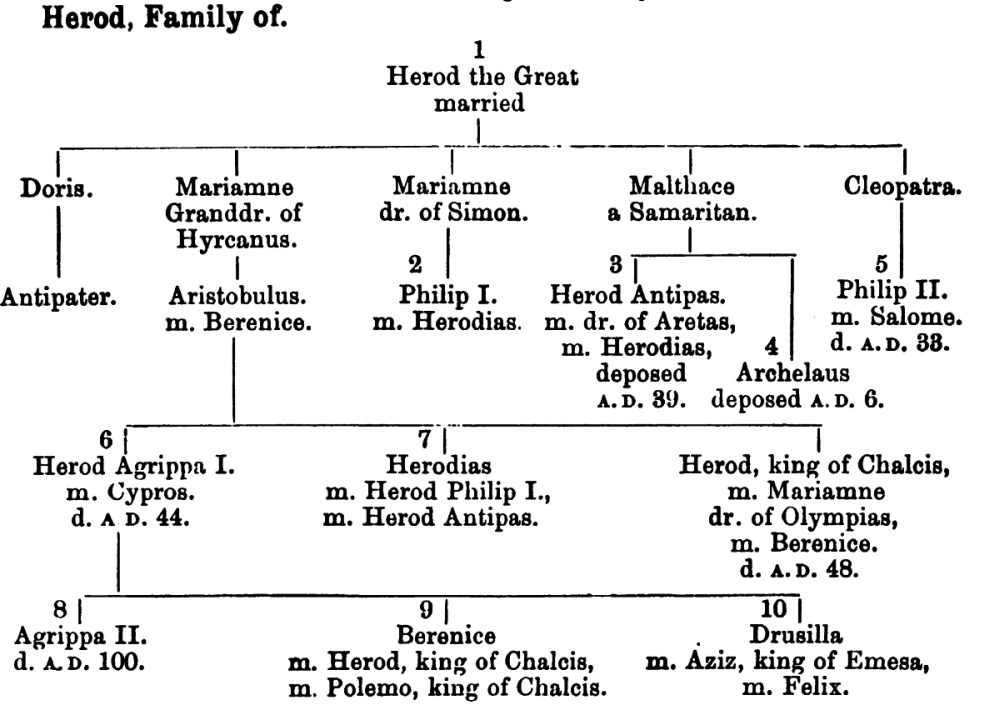
No. 1 is mentioned as 'Herod the king' in Matt. 2:1-22; Luke 1:5
No. 2. Philip, Matt. 14:3; Mark 6:17; Luke 3:19.
No. 3. Herod the Tetrarch, Matt. 14:1-6; Luke 3:1-19; Luke 9:7; Acts 13:1; the king,
Matt. 14:9; King Herod, Mark 6:14-22; Herod, Luke 13:31; Luke 23:7-15.
No. 4. Archelaus. Matt. 2:22.
No. 5. Philip tetrarch of Ituraea and Trachonitis. Luke 3:1
No. 6. Herod the king. Acts 12:1-21.
No. 7. Herodias. Matt. 14:3-6; Mark 6:17-22; Luke 3:19.
No. 8. King Agrippa. Acts 25:13; Acts 26:1-32.
No. 9. Berenice. Acts 25:13; Acts 26:30.
No. 10. Drusilla. Acts 24:24.
Herod Agrippa I. [Her'od Agrip'pa I]
Grandson of Herod the Great, and son of Aristobulus and Berenice. He was appointed by the emperor Caligula to the government of Ituraea and Abilene, with the title of king. Eventually he had the government of Judaea and Samaria given to him by Claudius. He was an observer of the law of Moses, and added to the extent of Jerusalem by a wall on the north of the city. It was he who put to death James the son of Zebedee to please the Jews, and imprisoned Peter, who was miraculously delivered. His miserable end is recorded in Acts 12.
Herod Antipas. [Her'od An'tipas]
Son of Herod the Great by Malthace a Samaritan. He succeeded his father in the tetrarchy of Galilee and Peraea. This was he whom the Lord called 'that fox.' He heard John the Baptist 'gladly,' yet put him to death. He was present at Jerusalem when the Lord was before Pilate, and by the courtesy of Pilate they settled their difference; but he treated the Lord with brutal indignity. He had married a daughter of Aretas king of Arabia, but subsequently induced Herodias the wife of Philip, his own half-brother, to leave her husband and live with him. This led to the death of John the Baptist by her desire, as recorded in scripture; and also to his being attacked and defeated with great loss by Aretas. Prompted by Herodias, he sought from the emperor Caligula the title of king (which did not belong to him though so called in Mark 6:14), but this ambition led to his perpetual banishment, A.D. 39. Herodias voluntarily accompanied him.
Herodians. [Hero'dians]
The name comes from Herod, and refers to those who took part with him and his successors in leavening the Jews with Grecian and Roman manners and licentiousness. In scepticism they sided with the Sadducees, but were strongly opposed to the Pharisees. This makes it the more striking that they should have united with the latter in endeavouring to entrap the Lord in His speech. Matt. 22:16; Mark 3:6; Mark 12:13. Their evil principles may well come under the term 'the leaven of Herod.' Mark 8:15.
Herodias. [Hero'dias]
See HEROD ANTIPAS and HEROD'S FAMILY.
Herodion. [Hero'dion]
Kinsman of Paul, saluted by him. Rom. 16:11.
Heron. [He'ron]
A bird that was unclean to the Israelites. The name anaphah cannot be identified, but several species of heron are found throughout Palestine, which are doubtless included because of the words 'after her kind.' The Ardea cinerea is a heron common in Palestine. They live upon fish, frogs, and reptiles. (R.V. margin has 'ibis.') Lev. 11:19; Deut. 14:18.
Hesed. [He'sed]
Father of one of Solomon's commissariat officers. 1 Kings 4:10.
Heshbon. [Hesh'bon]
Chief city of Sihon king of the Amorites. Lying on the east of the Jordan, it was the first city of importance that fell into the hands of the Israelites. The cause of their attacking it was that Sihon refused to let them pass through his land. This initial conquest is often referred to. Heshbon was subsequently assigned to Reuben, but became a Levitical city in connection with Gad. Num. 21:25-34; Deut. 2:24-30; Joshua 13:17-27; 1 Chr. 6:81. After the captivity it fell into the hands of the Moabites; and is denounced in the prophets. Isa. 15:4; Jer. 48:2, 34, 45; Jer. 49:3. Identified with Hesban, 31 48' N, 35 48' E. There are extensive ruins showing its former strength as a fortified city.
Heshmon. [Hesh'mon]
Town in the extreme south of Judah. Joshua 15:27.
Heth.
Second son of Canaan, from whom descended the HITTITES, q.v. They are often called 'the children of Heth.' Gen. 10:15; Gen. 23:3-20; Gen. 25:10; Gen. 27:46; Gen. 49:32; 1 Chr. 1:13.
Hethlon. [Heth'lon]
Place spoken of as 'the way of Hethlon:' only mentioned as the border of the land in the north to be possessed by Israel in the future. It is in the locality of Hamath. It is supposed to be identified with 'the entrance of Hamath.' Ezek. 47:15; Ezek. 48:1.
Hezeki. [He'zeki]
Son of Elpaal, a descendant of Benjamin. 1 Chr. 8:17.
Hezekiah. [Hezeki'ah]
1. Son of Neariah, of the royal house of Judah. 1 Chr. 3:23.
2. Ancestor of Ater whose descendants returned from exile. Ezra 2:16; Neh. 7:21.
Hezekiah, King of Judah.
Son and successor of Ahaz. Hezekiah "did that which was right in the sight of the Lord, according to all that David his father did." He trusted in the Lord God of Israel, so that there was none like him before or after. He reigned from B.C. 727 to 698.
Hezekiah began his reign by opening the doors of the house of the Lord, which was cleansed and repaired by the priests and Levites. Then he called the rulers, and sacrifices were offered as sin offerings for the kingdom and the sanctuary, and for Judah; songs were sung, and the king and all present bowed themselves and worshipped. He proposed to all Israel and Judah to come to the house of the Lord at Jerusalem to keep the Passover, and invitations were sent to all the tribes to turn to the Lord and to come and keep it. Though his messengers were in general mocked, there was a remnant that responded to the king's invitation. Such was the joy that after the seven days of unleavened bread they kept other seven days with gladness.
What naturally followed this worship was the removal of all signs of idolatry. Because the people had burnt incense to the brazen serpent, he brake it in pieces calling it 'a piece of brass.' He clave to the Lord, and the Lord was with him, and prospered him whithersoever he went.
The unfaithfulness of Ahaz had given the Assyrians a footing in Immanuel's land, against which Hezekiah rebelled, but afterwards submitted to pay tribute. Sennacherib required complete submission, and the Assyrians came with a great host against Jerusalem. Their general not only reviled Hezekiah, but spoke against God, comparing Him with the gods of the nations which the Assyrians had conquered. Hezekiah rent his clothes, covered himself with sackcloth, and went into the house of the Lord. God wrought deliverance. There was a rumour of opposition elsewhere, and the general departed. Of the Assyrians 185,000 were slain in one night: Sennacherib returned to Nineveh and was subsequently killed by two of his own sons.
We next read of Hezekiah's sickness, when Isaiah was sent to tell him to set his house in order, for he should die. Hezekiah wept sore and prayed for his life, and it was prolonged fifteen years. Though he had witnessed a great deliverance of the Lord, his faith was weak and he asked for a sign. God made the shadow go back ten degrees on the dial of Ahaz. But Hezekiah rendered not to the Lord according to the benefit done to him, for his heart was lifted up, therefore there was wrath upon him and upon Judah and Jerusalem. Yet, on Hezekiah humbling himself with the inhabitants of Jerusalem, the wrath came not in his days.
Hezekiah had great riches; and when Berodach-baladan, king of Babylon, sent ambassadors to him with a present, for they heard that he had been sick, and to inquire of the wonder that had been done in the land (doubtless the shadow going back ten degrees), Hezekiah showed them all his riches; and then he had to hear the sorrowful tidings that all he had shown them should be carried into Babylon, and his sons should be made eunuchs in the palace of the king of Babylon. Hezekiah piously resigned himself to the will of Jehovah. We read that God had "left him, to try him, that he might know all that was in his heart." It was pride; but God was gracious, and Hezekiah seemed to have the consciousness that God would give him peace and truth in his days. 2 Kings 18 - 2 Kings 20; 2 Chr. 29 - 2 Chr. 32; Isa. 36 — Isa. 39; Jer. 26:18-19; Hosea 1:1; Micah 1:1.
Hezion. [Hez'ion]
Grandfather of Benhadad king of Syria. 1 Kings 15:18.
Hezir. [He'zir]
1. Leader of the seventeenth course of priests. 1 Chr. 24:15.
2. A chief of the people who sealed the covenant. Neh. 10:20.
Hezrai. [Hez'rai]
A Carmelite, one of David's valiant men. 2 Sam. 23:35.
Hezro. [Hez'ro]
A Carmelite, one of David's valiant men. 1 Chr. 11:37. Doubtless the same as HEZRAI.
Hezron. [Hez'ron]
1. Son of Pharez, and grandson of Judah. Gen. 46:12; Num. 26:21; Ruth 4:18-19; 1 Chr. 2:5-25; 1 Chr. 4:1.
2. Son of Reuben. Gen. 46:9; Ex. 6:14; Num. 26:6; 1 Chr. 5:3.
3. Place on the south border of Judah. Joshua 15:3, 25; also called HAZOR. Identified by some with Jebel Hadireh, 30 52' N, 35 50' E.
Hezronites. [Hez'ronites]
Descendants of Hezron, son of Reuben and of Hezron, son of Pharez. Num. 26:6, 21.
Hiddai. [Hid'dai]
One of David's valiant men, 'of the brooks of Gaash.' 2 Sam. 23:30. Called HURAI in 1 Chr. 11:32.
Hiddekel. [Hid'dekel]
One of the rivers of Eden: supposed to be identical with the Tigris, which is called Dijlah. Gen. 2:14; Dan. 10:4.
Hiel. [Hi'el]
Native of Bethel who rebuilt Jericho in the reign of Ahab. In him was fulfilled the curse pronounced by Joshua that he should lay the foundation of the city in his firstborn and set up the gates in his youngest son. His building the city was a marked sign of insubordination.
1 Kings 16:34. Cf. Joshua 6:26.
Hierapolis. [Hiera'polis]
City of Phrygia in Asia Minor, for the saints of which Epaphras had a great zeal, or for whom he laboured much. Col. 4:13. Now called Pambuk Kalesi, 37 58' N, 29 11' E. It is remarkable for its hot calcareous springs, which have deposited curious incrustations.
Higgaion. [Higgai'on]
A Hebrew word that occurs four times, but in the A.V. is only once untranslated. This is in Psalm 9:16, where the margin reads 'that is, meditation.' It is thought by some to refer to a musical sign or instrument. Literally it means 'the sound of a harp when struck.' In Psalm 19:14 the word is translated 'meditation;' in Psalm 92:3, 'solemn sound;' and in Lam. 3:62, 'device.'
High Place.
The word commonly used for the high place is bamah, signifying what is high or elevated (cf. Ezek. 20:29), and then the hills on which altars were erected. There were such places in Canaan before the Israelites entered it, which they were told to destroy. Num. 33:52. If the Israelites had such, God would destroy them and cut down their images. Lev. 26:80.
In the above passages the high places are connected with idolatry; but it would appear that before the temple was built, altars for the worship of God had been erected elsewhere than at the tabernacle. With Samuel at Zuph, there was 'a sacrifice of the people' in the 'high place' (God having forsaken the tabernacle at Shiloh, this disorder resulted). It was evidently on elevated ground, for they went up to it and came down. 1 Sam. 9:12-25. At the beginning of the reign of Solomon the people sacrificed in high places because the temple was not yet built. This was failure, for we read that "Solomon loved the Lord, walking in the statutes of David his father: only he sacrificed and burnt incense in high places." 1 Kings 3:2-4. The tabernacle was there (Gibeon), 1 Chr. 16:39; 2 Chr. 1:3, so that it appeared to be the right place to go to, and it was where God appeared to Solomon in the night; yet it was 'the great high place.' The reason of this implied disapproval is doubtless because the ark was not there, the symbol of God's presence, which was the true place of worship. At the close of Solomon's life he sinned greatly in building a high place for the gods of all his strange wives. 1 Kings 11:7-8. On the division of the kingdom, Jeroboam set up his idols and "ordained him priests for the high places, and for the devils, and for the calves which he had made." 2 Ch. 11:15. With these two examples it is not surprising that in the whole land there were many high places. Hezekiah and Josiah zealously destroyed the high places, which included the buildings thereon and the idols connected therewith. The word bamah is used apparently for any idolatrous erection, for we once read of high places in a valley. Jer. 7:31.
The term 'high places' has another application under the Hebrew word ramah, which also signifies 'exalted;' for Israel is charged with making a high place in every street, and at every head of the way, which doubtless refers to some shrine or symbol of idolatry connected with abominable practices. Ezek. 16:24-25, 31, 39. They courted the favour of the heathen by adopting their idolatrous worship and customs.
High Priest
It is remarkable that this title occurs but seldom in the O.T. Lev. 21:10; Num. 35:25; Joshua 20:6; 2 Kings 12:10; 2 Chr. 24:11, etc. Aaron was constantly called 'the priest;' but as his sons were also called priests, he was necessarily the 'chief' and would correspond to what is called high priest in the N.T. His office is summed up in few words: he "is ordained for men in things pertaining to God" that he might offer both gifts and sacrifices for sins. He stood for the people to God: he offered up the sacrifices which put the people in relation with God (Lev. 9), also those on the day of atonement (Lev. 16), and he blessed them as from God. He, as taken from among men, was one who could have compassion on, or forbearance toward, the ignorant and the erring; for that he himself was compassed with infirmity. Heb. 5:1-2. Aaron did not take the honour upon himself, nor did Christ. Heb. 5:4-5. Having accomplished redemption by the offering of Himself, He passed through the heavens and sat down on the right hand of God. He is touched with the feeling of our infirmities, having been Himself tempted as we are, apart from sin. He ever lives to make intercession for us, He is also the minister of the sanctuary — He appears in the presence of God for us, and is the great Priest over the house of God. Heb. 4:14-15; Heb. 8:1, etc. See AARON, AARONIC PRIESTHOOD, MELCHISEDEC.
Hilen. [Hi'len]
City in Judah assigned to the priests. 1 Chr. 6:58. Called HOLON in Joshua 15:51; Joshua 21:15. Identified by some with Beit Alam, 31 35' N, 34 57' E.
Hilkiah. [Hilki'ah]
1. Father of Eliakim, the head of Hezekiah's household. 2 Kings 18:18, 26, 37; Isa. 22:20; Isa. 36:3, 22.
2. Son of Shallum, or Meshullam, and high priest in the time of Josiah king of Judah. He found a copy of the law in the temple, which caused great heart-searchings and repentance. 2 Kings 22:4-14; 2 Kings 23:4, 24; 1 Chr. 6:13; 1 Chr. 9:11; 2 Chr. 34:9-22; 2 Chr. 35:8; Ezra 7:1; Neh. 11:11.
3. Son of Amzi, a Merarite. 1 Chr. 6:45.
4. Son of Hosah, a Merarite. 1 Chr. 26:11.
5. One who stood by Ezra when he read the law. Neh. 8:4; probably the priest in Neh. 12:7, 21.
6. Priest of Anathoth and father of the prophet Jeremiah. Jer. 1:1.
7. Father of Gemariah. Jer. 29:3.
Hill Country.
Any part of the range of hills that runs through Palestine from north to south, in distinction from the plains towards the Mediterranean or the Jordan; and in distinction from the Shephelah which is a region in Judah that runs between the hill country and the plain on the west, called the 'lowlands.' Joshua 13:6; Luke 1:39, 66.
Hillel. [Hil'lel]
A Pirathonite, father of Abdon one of the judges of Israel. Judges 12:13, 15.
Hin.
See WEIGHTS AND MEASURES.
Hind.
The word ayyalah is supposed to allude to any kind of deer found in Palestine: no particular species can be identified. It is used as a symbol of activity. Gen. 49:21; 2 Sam. 22:34, Ps. 18:33; Ps. 29:9; Cant. 2:7; Cant. 3:5; Hab. 3:19. See HART.
Hinge.
The only hinges handed down from antiquity are pivots projecting above and below the door, on which the door turned. In the temple the hinges were of gold, and may have been of this description. 1 Kings 7:50; Prov. 26:14. In ancient existing houses with stone doors the hinges are stone projections at the top and bottom of the doors.
Hinnom, [Hin'nom] Valley of.
This is often called 'the valley of the son of Hinnom,' but who Hinnom and his son were is unknown. Joshua 15:8; Joshua 18:16; Neh. 11:30. The valley running from east to west, on the south of Jerusalem, now bears the above name. In some part of this, supposed to be the east end, children were passed through the fire to false gods. Jer. 7:31-32; Jer. 32:35. To prevent this Josiah defiled TOPHETH in this valley. 2 Kings 23:10; 2 Chr. 28:3; 2 Chr. 33:6. The prophet Isaiah gives the key to its being associated in the N.T. (under the name of GEHENNA) with eternal punishment: "Tophet is ordained of old; yea, for the king it is prepared; he hath made it deep and large: the pile thereof is fire and much wood; the breath of the Lord, like a stream of brimstone, doth kindle it." Isa. 30:33. See HELL. In God's judgements the valley shall become the 'valley of slaughter.' Jer. 19:2-14.
Hirah. [Hi'rah]
An Adullamite, a friend of the patriarch Judah. Gen. 38:12.
Hiram. [Hi'ram]
1. King of Tyre, who loved David and was a friend of Solomon. By his servants he supplied both timber and stone for the temple and the palaces of Solomon. Their navies also united to bring the produce of other lands. Solomon gave to Hiram twenty cities in the land of Galilee, but Hiram was not pleased with them: he called them, in Aramaic CABUL, 'displeasing or dirty;' and the cities were eventually returned to Solomon. 2 Sam. 5:11; 1 Kings 5:1-18; 1 Kings 9:11-27; 1 Kings 10:11, 22; 1 Chr. 14:1, etc. He is called HURAM in 2 Chr. 2:3-12; 2 Chr. 8:2, 18; 2 Chr. 9:10, 21.
2. A skilful workman of Tyre, filled with wisdom and understanding, who was sent to make things for the temple. His father was a man of Tyre, and he is called "the son of a woman of the daughters of Dan" in 2 Chr. 2:14; but in 1 Kings 7:14 it reads "a widow's son of the tribe of Naphtali," which may mean that her husband was a man of Naphtali. 1 Kings 7:13, 40, 45. He is called HURAM in 2 Chr. 2:13; 2 Chr. 4:11, 16.
Hireling, Hired Servant.
These were distinct from the house servants who were generally slaves. Hired servants were engaged by the day and paid at the close of the day. A servant hired by the priest was not regarded as one of the family, and was not allowed to eat of the holy things, whereas the slaves were considered a part of the family. Lev. 19:13; Lev. 22:10; Deut. 15:18; Deut. 24:14; Job 14:6; Mal. 3:5. They are contrasted in the N.T. with the Shepherd who owned the sheep. Matt. 20:1-8; Luke 15:17, 19; John 10:12-13.
Hittites. [Hit'tites]
The descendants of Heth, a son of Canaan, and hence descendants of Ham: a numerous race who inhabited Palestine. In God's covenant with Abraham their territory was to be possessed by his descendants. Gen. 15:20. On the death of Sarah, Abraham bought the field and cave of Machpelah from the Hittites. His intercourse and contract with them show that they were a civilised race, used to commercial transactions. Gen. 23:3-20. This was near or at Hebron in the south of Palestine, whereas other passages speak of them in the north, between the Lebanon and the Euphrates, which was probably where they originally settled, Joshua 1:4; and there are intimations that they continued a powerful and warlike race after Palestine was possessed by Israel. 1 Kings 10:29; 2 Kings 7:6. Ahimelech and Uriah, eminent men in the time of David, were Hittites. 1 Sam. 26:6; 2 Sam. 23:39.
In various parts of Palestine and Syria monuments have been found of the Hittites, and in Egypt there are records of a long defensive treaty that was made between the Egyptians and the Hittites, showing that the latter were an important race. The Tell Amarna tablets show that they seized upon Damascus then held by Egypt. Letter after letter urged Egypt to come to the rescue. Their features even are now well understood on the monuments, being described as a people with yellow skins and 'mongoloid ' features, receding foreheads, oblique eyes, and protruding upper jaws.
Hivites. [Hi'vites]
One of the races found early in Palestine: they were descendants of Ham through Canaan. Gen. 10:17. Jacob, on his return to Palestine, found Shechem occupied by the Hivites. Gen. 34:2. They also possessed Gibeon, and found means to deceive Joshua into making a league with them. Joshua 9:3, 7. They seemed to be more a commercial than a warlike people. We also find the Hivites in the north in mount Lebanon, and Israel was beguiled into making marriage contracts with them. Judges 3:3, 5, 6. In the days of Solomon they were still in the land, and were made tributary to Israel. 1 Kings 9:20. Israel suffered through not carrying out the directions of God to cast out these and other inhabitants of the land. They were by them led into idolatry.
Hizkiah. [Hizki'ah]
Ancestor of Zephaniah the prophet. Zeph. 1:1.
Hizkijah. [Hizki'jah]
One who sealed the covenant. Neh. 10:17.
Hobab. [Ho'bab]
This name occurs only in Num. 10:29 and Judges 4:11. He was apparently the father-in-law of Moses, and if so he is the same as Jethro. See JETHRO.
Hobah. [Ho'bah]
Place 'on the left hand,' that is, to the north of Damascus, to which Abraham pursued the kings who had captured Lot. Gen. 14:15. The Muslims point out Burzeh, 33 32' N, 36 8' E, as the ancient Hobah; but the Jews prefer Jobar, about two miles N.E. of Damascus.
Hod.
Son of Zophah, of the tribe of Asher. 1 Chr. 7:37.
Hodaiah. [Hoda'iah]
Son of Elioenai, a descendant of David. 1 Chr. 3:24.
Hodaviah. [Hodav'iah]
1. A chief of Manasseh on the east of the Jordan. 1 Chr. 5:24.
2. Son of Hasenuah, a Benjamite. 1 Chr. 9:7.
3. Ancestor of some Levites who returned from exile. Ezra 2:40. Called HODEVAH in Neh. 7:43.
Hodesh. [Ho'desh]
Wife of Shaharaim, a Benjamite. 1 Chr. 8:9.
Hodevah. [Hode'vah]
See HODAVIAH, NO. 3.
Hodiah. [Hodi'ah]
One of the wives of Ezra, of Judah. 1 Chr. 4:19. The same apparently as JEHUDIJAH, which signifies 'the Jewess,' in 1 Chr. 4:18.
Hodijah. [Hodi'jah]
1, 2. Levites who returned from exile and sealed the covenant. Neh. 8:7; Neh. 9:5; Neh. 10:10, 13.
3. A chief of the people who sealed the covenant. Neh. 10:18.
Hoglah. [Hog'lah]
One of the daughters of Zelophehad. Num. 26:33; Num. 27:1; Num. 36:11; Joshua 17:3.
Hoham. [Ho'ham]
King of Hebron, one of the five kings put to death by Joshua at the cave of Makkedah. Joshua 10:3, 17-26.
Holiness.
Holiness has been described as "a nature that delights in purity, and which repels evil." Adam and Eve were 'innocent,' not holy; for though they might have delighted in purity, they did not repel the evil of Satan. God is ever holy; in heaven there is no evil to separate from, and He was holy, consistent with His perfection in everything, before there was any evil. The Spirit is the Holy Spirit though He is down here where sin is, and the Lord Jesus when in this sinful world was holy, harmless, and undefiled. God is called 'the Holy One of Israel,' Isa. 30:15, etc., and the Lord Jesus 'the Holy One.' Mark 1:24; Acts 3:14.
The Israelites having been redeemed out of Egypt, and separated to God, it was said to them, "Thou art a holy people unto the Lord thy God: the Lord thy God hath chosen thee to be a special people unto himself, above all people that are upon the face of the earth." Deut. 7:6. They were viewed as the chosen of God, as set apart for Him. This should have led to practical holiness, as God said, "Be ye holy, for I am the Lord your God." Lev. 20:7. The Christian also is sanctified and justified, and Christ is made of God sanctification to him (1 Cor. 1:30), referring to the separative call of God, and the means and measure of his sanctification. As new created in Christ he partakes of the divine nature, so that holiness is followed. He is chastened also by the Father of spirits in order to his being partaker of God's holiness.
One has said, "The Christian is called holy because he is set apart for God absolutely, according to the rights won by Christ in His death, and made good when he is born again, and thus set apart in a real way; and more perfectly, and with more intelligence, when he is sealed by the Holy Ghost, as cleansed by the blood of Christ." Upon this are based the practical exhortations: "As he which hath called you is holy, so be ye holy in all manner of conversation." 2 Cor. 7:1; 1 Thess. 4:7; Heb. 12:14; 1 Peter 1:15; 2 Peter 3:11.
Holon. [Ho'lon]
1. City of Moab in the low country, east of the Jordan. Jer. 48:21. Not identified.
2. City in Judah. See HILEN.
Holy-day.
Applied to the Sabbath or any of the Jewish festivals. Ex. 35:2; Ps. 42:4; Col. 2:16.
Holy Ghost, Holy Spirit.
The third Person in the Trinity, as seen in the formula of baptism. Matt. 28:19. The Spirit moved upon the face of the waters at the creation, Gen. 1:2; and He came upon certain persons in the O.T. to fulfil the purposes of God. David asked that the Holy Spirit might not be taken from him, Ps. 51:11; which stands in contrast to the indwelling of the Holy Spirit in Christians, for He abides with them. It is by the operation of the Spirit that they are born anew, and He is the seal of their faith in Christ, and the earnest of their inheritance above. John 3:5; Eph. 1:13-14. He is their COMFORTER or Advocate (παράκλητος, one who manages their affairs) on earth, as Christ is the same in heaven. John 14:16, 26.
Though the Holy Spirit influenced and came upon the O.T. saints, He did not come personally until Christ had ascended. John 16:7. Many passages prove His personality — a matter of great importance, often lost sight of by those who constantly speak of Him as an influence. Ananias lied to the Holy Spirit. Acts 5:3. "The Holy Ghost said, Separate me Barnabas and Saul," etc. Acts 13:2. "Dividing . . . . as he will." 1 Cor. 12:11. The Holy Spirit directed the labours of Paul and his companions, Acts 16:6-7, and the Lord Jesus cast out demons by the Spirit of God. Matt. 12:28.
His presence and operations here are some of the fruits of Christ's exaltation. He forms Christ in the believer. He is also the power of life and the power for testimony. Indwelling the saints individually, He forms them collectively into one body, they are also builded together for a habitation of God through the Spirit. 1 Cor. 3:16; Eph. 2:22.
To be indwelt by the Holy Spirit is an immense favour, for He is a divine Person: any one so indwelt is not in the flesh, but in the Spirit. He is the Spirit of sonship and by him the believer cries, Abba Father. Christians are exhorted to be guided by Him, and neither to quench nor to grieve that holy One. Our responsibility is to "walk in the Spirit." Gal. 5:16.
His presence on earth is a demonstration as to the world of sin, of righteousness, and of judgement. John 16:8-11.
Homam. [Ho'mam]
See HEMAM.
Homer
See WEIGHTS AND MEASURES.
Honest, Honesty.
These words in the N.T. are not confined to trustworthiness, as the words are now commonly understood; but extend to any honourable conduct. Luke 8:15; Rom. 12:17; 2 Cor. 8:21; 2 Cor. 13:7; Phil. 4:8; 1 Tim. 2:2; Heb. 13:18; 1 Peter 2:12.
Honey.
This was so plentiful in Palestine, that the country was often described as a land 'flowing with milk and honey.' Ex. 3:8, 17. It is symbolical of what is sweet in nature; to be partaken of with discretion, lest it cause vomiting. Prov. 25:16, 27. It was strictly forbidden to add honey to the offerings of the Lord made by fire. Lev. 2:11. What is of nature, though it be sweetness, can have no place in what is offered to God. The Lord Jesus when in service on earth said to His mother, "Woman, what have I to do with thee?" though when His service was over He commended her to John.
Hope.
This is described as waiting for something that is not seen but which has been promised. Rom. 8:24-25. Blessed is the man whose hope the Lord is; though troubles arise he will not cease to bear fruit. Jer. 17:7-8. There is nothing vague in the Christian's hope: it is an anchor of the soul, sure and steadfast, because the Lord Himself is his hope, and Christ in him is the hope of glory. Col. 1:27; 1 Tim. 1:1; Heb. 6:18-19. The coming of the Lord, and not death, is a blessed part of the Christian's hope. 1 Thess. 4:13-18; 1 John 3:2-3.
Hophni. [Hoph'ni]
Son of Eli the priest. He and his brother Phinehas also acted as priests; but their sin was very great both respecting the offerings of the Lord and as to their moral conduct. Their father reproved them, but did not restrain them. They accompanied the ark to the war with the Philistines and were both slain. 1 Sam. 1:3; 1 Sam. 2:34; 1 Sam. 4:4-17.
Hophra. [Hoph'ra]
See PHARAOH HOPHRA.
Hor, Mount.
1. The mountain on which Aaron died when the Israelites were near the end of their wanderings. Num. 20:22-28; Num. 21:4; Num. 33:37-41; Deut. 32:50. Identified with Jebel Neby Harun, about 30 18' N, 35 25' E. It is the range of mountains on the eastern side of the wady Arabah; from which the scene of mountain peaks is described as awfully majestic.
2. A mount on the northern boundary of the land. Num. 34:7-8. Probably one of the peaks of Lebanon, but not identified.
Horam. [Ho'ram]
King of Gezer conquered by Joshua. Joshua 10:33.
Horeb. [Ho'reb]
A mount closely connected with Sinai, and supposed to embrace the range of mountains lying about 28 30' N, 33 57' E between the Gulf of Suez and the Gulf of Akaba, whereas Sinai is one of the mountain peaks. Horeb was called 'the mountain of God.' Ex. 3:1. It was where God had intercourse with Moses, and where He made a covenant with Israel. Near here also the golden calf was set up. Ex. 17:6; Ex. 33:6; Deut. 1:2, 6, 19; Deut. 4:10, 15; Deut. 29:1; Ps. 106:19. See SINAI.
Horem. [Ho'rem]
Fenced city in Naphtali. Joshua 19:38. Identified with ruins at Harah, 33 10' N, 35 26' E.
Horhagidgad. [Hor-hagid'gad]
Station of the Israelites in the wilderness. Num. 33:32-33. Perhaps the same as GUDGODAH in Deut. 10:7.
Hori. [Ho'ri]
1. Son of Lotan, a descendant of Seir the Horite. Gen. 36:22, 30; 1 Chr. 1:39.
2. Father of Shaphat of the tribe of Simeon. Num. 13:5.
Horims, [Ho'rims] Horites. [Ho'rites]
Descendants of Seir, and Aborigines of mount Seir. They were destroyed by the children of Esau. Gen. 14:6; Gen. 36:20-21, 29; Deut. 2:12, 22. It is thought that they were cave-dwellers, as the name implies. The sandstone rocks of mount Seir are full of excavated dwellings, and there are traces of the same throughout the region of Edom.
Hormah. [Hor'mah]
The name signifying 'utter destruction' given to ZEPHATH in the far south when conquered by Judah and Simeon. Num. 14:45; Num. 21:3; Deut. 1:44; Joshua 12:14; Judges 1:17;
1 Sam. 30:30; 1 Chr. 4:30. Identified by some with ruins at S'baita, 30 52' N, 34 42' E.
Hornet.
The insect tsirah is of the wasp kind. God promised to send these insects before the Israelites to drive out the inhabitants of the land of Canaan. Ex. 23:28; Deut. 7:20; Joshua 24:12. Travellers relate that when a nest of such insects has been disturbed, the animals and people have fled in terror, the stings being very painful, and occasionally causing death. Some hang their nests to the boughs of trees, and these may be disturbed by an animal passing underneath.
Horns.
These are referred to in scripture as
1. On the altar, the projections placed at its corners, on which the blood of the sacrifices was placed, and to which culprits clung for protection. Ex. 38:2; Lev. 4:7; 1 Kings 1:50.
2. For trumpets, especially rams' horns. Joshua 6:4-13.
3. For holding oil. 1 Sam. 16:1, 13.
4. For holding ink. Ezek. 9:2-3.
5. They were worn in the East as a symbol of exaltation and power. Jehovah was David's horn of salvation. He exalted the horn of His people, and brake the horns of the wicked. Ps. 18:2; Ps.75:10; Ps.148:14.
6. Horns are spoken of frequently in Daniel and the Revelation as a symbol for kings: "the ten horns which thou sawest are ten kings." Dan. 7:7-24; Dan. 8:3-21; Rev. 12:3; Rev. 13:1; Rev. 17:3-16.
Horonaim. [Horona'im]
Place in Moab, mentioned by the prophets, with Zoar and Luhith. Isa. 15:5; Jer. 48:3, 5, 34. The name of Horonaim is found on the Moabite stone: it was taken by King Mesha.
Horonite. [Hor'onite]
Designation of Sanballat, probably as a native of Horonaim or of Beth-horon. Neh. 2:10, 19; Neh. 13:28.
Horse.
The horse was used among the Israelites only for war, either in chariots or for what is now called cavalry; but its use betokened failure in confidence on the Lord: see Hosea 14:3. They had been forbidden to multiply horses, Deut. 17:16; and at first they hamstrung the horses, and burnt the chariots of the Canaanites. Joshua 11:6, 9. David, however, after the defeat of Hadadezer, reserved 100 horses for chariots. 2 Sam. 8:4. (See a description of the war-horse in Job 39:19-25.) Solomon had 40,000 stalls of horses for his chariots and 12,000 horsemen. 1 Kings 4:26.
Symbolically the horse represents careering imperial power, in general providentially controlled. In the early part of Zechariah the prophet had visions of horses of different colours, they are called spirits of the heavens, and as such they acted in the four great Gentile empires described by Daniel. When these are further spoken of, the red horses are not named, for the Chaldean empire had passed away when Zechariah saw the vision. Zech. 1:8; Zech. 6:1-7.
In the Revelation also there are horses and riders thereon, representing the powers engaged in the providential course of God's dealings. Rev. 6:1-8; cf. Rev. 9:7, 9, 17. In Rev. 19 the Lord Jesus, the Faithful and True, comes forth on a white horse, to make war in righteousness. Rev. 19:11-21. See REVELATION.
Horseleech.
Leeches are abundant in Palestine, and the horseleech may simply refer to a large species that would settle on a horse's foot if placed in the water where they abound. A horse has been known, in drinking, to get a leech into its mouth, which immediately began to suck its blood. The leech is used symbolically of a rapacious person, who is never satisfied, graphically delineated by the leech's two daughters, who say, 'Give, give.' Prov. 30:15.